Moving Back to Canada
Resources for Expatriate Canadians returning to Canada after living in the U.S. or further abroad
Moving Back to Canada
Resources for Expatriate Canadians returning to Canada after living in the U.S. or further abroad
Transferring Money and Foreign Exchange
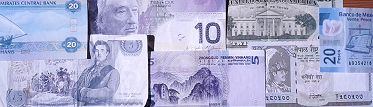
This is one of the more important aspects of returning to Canada for citizens who have lived abroad for many years and want to repatriate some or all of their money back to Canada and have it converted into Canadian dollars ("CAD"). There are several aspects to transferring money and foreign exchange:
- Part 1: Timing - when do you need your money to be in Canadian dollars?
- Part 2: "Hedging" - balancing your risk.
- Part 3: Foreign Exchange and Transferring Money to Canada - if you need to exchange currencies and transfer large amounts of money to Canada in anticipation of moving back, you will want to read this section.
- Part 4: Offshore banking - where to keep your money so it is safe and so you can move it quickly and easily around the world to take advantage of opportunities and to prepare for potentially changing personal circumstances.
Part 1: Timing

The key word for understanding foreign exchange is timing.
When moving back to Canada some years ago, I personally fell into the trap of wanting to have all of my money in Canada when I arrived back. I converted our holdings to CAD and set up life in Canada with those funds before I actually returned. Due to exchange rate changes in the months preceding our return, I lost CAD 14,000 on the conversion rate difference from my earlier projections. Had I waited for a more favourable rate, I could have recouped most or all of these lost monies. As exchange rates go up and down over weeks, months, and years due to a combination of sudden shocking events and fairly clear patterns, timing becomes the key variable for your consideration.
As of the latest update to this document, the Canadian dollar (CAD) is at a low level compared to the US$ (USD). Given this situation, should you convert some or all of your foreign currency back to Canadian dollars right now?
- If you are considering converting USD, this is a great time! The Canadian dollar may go a bit lower, or it may go higher in the coming months, but the current low rates mean that your USD now gets you lots of CAD compared to pre-2020 years.
- If you are converting from GBP to CAD, the rates are not that different from what they were in the recent past. There have been ups and downs in the exchange rate due to past BREXIT implications, but there seems to be less volatility as compared to the USD - CAD rates. So perhaps there is less of a timing issue if you want to convert GBP to CAD.
- Euros, Francs, Pounds, Pesos, or other currencies? Check out some of the considerations, below, before deciding when to convert your foreign currencies back to CAD.
In summary, timing is the key consideration for moving some or all of your monies back to Canada when you are returning to reside here.
Timing Considerations: "When should I convert to CAD?"
Key Question: When will you need the money in Canada?
Major costs in Canada when you return can be the purchase of real estate for living in or as an investment, a vehicle, or even money for post-secondary education for your child. Living expenses in major cities in Canada are continually rising so plan on having enough cash in Canada to live comfortably, too. Clearly, bringing some money to Canada is essential.
But how much?
Considerations:
- If you have holdings of currencies that are strong now on a historical basis, consider moving more money now. Access to historical rates on foreign exchange company sites is free and easy to find on the internet.
- If you have holdings of a currency that you think will appreciate against the CAD, perhaps you can leave some or most of these holdings off-shore. Canadian mortgage rates are quite low right now compared to previous decades. If you feel you can make more than your mortgage interest rate on future valuation increases in your foreign currency, maybe you can feel comfortable holding a mortgage in Canada while leaving your money off-shore. Some people can and some people can't feel comfortable doing so.
For some people, this doesn't make sense and has emotional implications. For others, money is just a variable they can play with unemotionally and they feel quite happy knowing they have mixed currencies and holdings around the world. - Do you really need the money now in Canada? Money can be moved very quickly around the world today - within hours or at the longest day (within a 2-3 days typically). Banks like HSBC, which specialize in being "international" in nature, can move money very quickly. Perhaps you can wait some months or years, until exchange rates are favourable, knowing you can access your funds quickly and easily when you will need them?
- Taxes: If you are coming back to Canada and will be working here, Registered Retirement Savings Plans (RRSP's) can be a very useful tool for minimizing your taxes. Bringing enough holdings to contribute to your RRSP's may make strategic sense. Leaving the funds off-shore might not be as beneficial in this case.
Another wonderful tax saving tool in Canada for residents here is a Tax Free Savings Account (TFSA), which in 2024 you can contribute CAD $7,000 into (per person = $12,000 per couple annually). Another good reason to have money in Canada for when you move and can start using these tools.
The USD - CAD Dilemma
Note: I have also added some USD foreign exchange considerations to the "Moving Back to Canada from the USA" page, which can give you some more general considerations for those living there.
The opportunity facing Canadians considering moving their USD funds to CAD is embodied in this chart:

Source of the data for this graph: OFX - Foreign Exchange.
Quite simply, the rest of 2026, and a longer projection into 2027 and beyond, of the USD is anyone's guess but in 2026 so far the USD has been very strong compared to the CAD. This is certainly a good time to move money to CAD from USD from a longer term historical perspective but significant fluctuations may occur in the near future and so timing your transfers with care is advised. Note: The USD is very strong at the time of this latest update in Q3 2025 but there are so many variables changing in world economics at this time which makes it a challenge to predict what will happen in the coming months...so keep an eye on rates going forward to the end of 2026 and into 2027 as these are shaping up to be "interesting" years in the U.S., Canada, and many places in the world. Hedging investments into more than just USD and CAD is advisable (see the section below on hedging)
Check today's current USD to CAD exchange rate:
Note: Exchange rates change every minute and the rates quoted here are "Market" rates. Your final exchange rate will vary from it (more or less to you) depending on the rate at the time of your transaction.
Considerations
This leaves Canadians moving back to Canada with some fundamental questions to consider:
- What is the trend for the next year or two?
- Do I convert now or later?
- Should I keep my money in a mix of both currencies?
If you need the money to be in Canada now, or very soon, exchanging now from USD may save you from future losses from a poorer exchange rate. If you are exchanging GBP to CAD, ongoing post-BREXIT economic changes could go either way: Strengthening the GBP or weakening it, so there is no definitive timing implication for that currency. Australian Dollars? The AUD has fluctuated and looking at short term economics of both countries can help you understand what might come next for AUD and CAD.
If you can wait for the very long term (5-10 years +), You can more accurately match any currency's high exchange rate to your needs.
If you are not in a rush to move your money back to Canada, and want to balance the risk of your holdings (called "hedging"), perhaps keeping 40% in USD, 40% in CDN, and the remaining 20% in EUR, YEN, or CNY (RMB) would make sense. More below, in "Part 2: Hedging".
The Canadian Economy - Past, Present, and Future
"Hewers of wood and drawers of water"
This used to describe the early Canadian economy. Resource-based. And we did most of our trade with the U.S.

Today, the Canadian economy is more diversified, but we still retain some of the economic pillars of the past. What Canada looks like now:
- Construction, real estate sales, and real estate financing are now together the largest industry in Canada. They are so big that they are huge risk to our economy. As of the latest update to this document Canada's real estate price bubble is so huge it is out of synch with incomes by the largest disparity among all Western economies.
- High tech and entertainment (film, video, and game production) are now a very important part of the Canadian economy, and growing.
- Resources still represent a significant portion of our economy but are now smaller as a whole than real estate. They are tied into construction as lumber, for example, is used widely in construction.
- Vehicle and parts manufacturing is still an important component of our economy, particularly in Ontario. There are big changes happening such as some manufacturing switching over to electric vehicle production, which bodes well for the future.
- Banking and financial services are strong in terms of value, but employment is starting to shrink due to automation.
- Government employment represents a strong part of our economy.
The challenge for the present and future? We still do a very large portion of our trade with the U.S.!
Another old saying:
"When America sneezes, Canada gets a cold".
Given our reliance on the U.S. for trade, and the fact that the U.S. population and economy is 10 times the size of Canada's, is there cause for concern when this friendly neighbour gets economically sick?
Yes.
Implications:
The simplest and most clear message coming from Canadian reliance on our economically significant neighbour to the south is that you might consider holding a significant part your financial investments outside of Canada and the U.S., in foreign currencies and investments. Switzerland, Germany, Brazil, and Japan all offer an opportunity to off-set economic risk in the U.S., and by association, Canada.
This is more complex stuff. If you have significant financial holdings in a foreign currency I suggest you consult with a financial advisor who understands currencies, specifically.
Part 2: Hedging
"Hedging" simply means balancing your risk or "not putting all your eggs in one basket".
When one currency goes up another goes down, by default. Obviously you want to be invested more in currencies that go "up" over time and not down. However, this is devilishly hard to predict, per the timing issue noted above.
For most people, this means you need another tool: Owning more than one currency so that when one goes down, you have another that goes up. You won't make any major gains on your money from a currency value perspective...but you won't ever lose much, either, assuming you have spread your risk across a few currencies.
If you are getting paid in one currency, and putting away savings for the future, hedging is a powerful risk reduction tool for you.
Here is an example mix, assuming you are still living overseas or are returning to Canada but do not want to immediately convert all your funds:
You have Australian dollars (AUD) 100,000. Here is how you might hedge it:
AUD 40,000 (40%)
USA 21,000 (20%)
EUR 16,000 (20%)
CDN 21,000 (20%)
(The above is just an example to illustrate hedging and the actual amounts will fluctuate based on changing exchange rates).
Another example mix, if you want to be a bit more widely invested:
AUD 20,000 (20%)
EUR 16,000 (20%)
CDN 21,000 (20%)
CHF 19,500 (20%)
JPY 37,000 (20%)
Important note: This currency "hedging" will not likely be in cash that is held in bank accounts, to be clear. If you have an investment account (stocks, bonds, ETF's, etc.) you can hedge across currencies by holding bonds or bond ETF's, for example, that are denominated in different currencies. This way you can achieve not only currency valuation stability, but some income from your money, too.
Holding multiple currencies might seem complicated, but it really is quite simple. If in doubt, always hold at least 2 different major currencies, ones that are not closely tied together. For example, the USD and CDN are too closely tied together. Having these two currencies is not considered an effective risk management strategy. CDN and EUR are not as closely tied together. Holding funds in these two currencies would be the start of an effective hedge strategy.
Part 3: Transferring Money to Canada - Foreign Exchange Considerations

This is simple, right?
You sell your house in California, for example, and tell your bank to wire transfer the USD$800,000 you got from the sale to your Canadian bank account and all is good. Easy.
Or...you are in Hong Kong and are moving back to Vancouver, for example. You simply have your HK bank wire your HKD or USD savings to your Canadian bank account and your Canadian bank does the foreign exchange to CAD as the money arrived in Canada. Easy.
Or...you have your monthly U.S. IRA / ROTH IRA / 403b / 401k / etc. payment deposited into your Canadian bank account and converted to CAD by your bank when it arrives. Easy.
(Yeah! This was the shortest section on the whole web site!)
But wait a minute...! There are a few important things to be aware of:
- Did you know you are giving banks juicy profits? Use a foreign exchange company to get the best exchange rates!
- Foreign exchange gains realized outside of Canada are not taxable in Canada for non-residents
- Foreign exchange gains realized within Canada are taxable in Canada for non-residents
First...
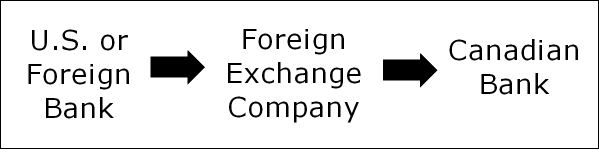
Use a foreign exchange company!
Did you know that banks generally give you the worst foreign exchange rate and have the highest fees?
Most of my clients are now using private foreign exchange companies to transfer their funds to Canada. They convert their USD, EUR, GBP, and other currencies to CDN dollars at a much better exchange rate and with much lower fees than using foreign or Canadian banks.
Will you be transferring $500 to Canada? Then in this case use your bank for doing the exchange to CDN. It is a very small amount and using a foreign exchange company won't make much difference.
However, if you are transferring $2,000, $5,000, $10,000, $25,000, $50,000, $100,000, $500,000, or $1,000,000+ there will be a growing and very big difference the larger the transfer size. Using a foreign exchange company will mean substantial savings. Typically hundreds and usually thousands of dollars in savings at the time of a single transfer or over a period of a year if you are doing monthly transfers!
From my clients:
So for a few hours of my time researching and testing and getting the OFX option to work I paid myself $27K [foreign exchange savings over using a bank]...for moving funds this is huge.
I figure we saved $4,000! I couldn't believe it!
Based on comparing the bank's exchange rate with the rate I was given with Knightsbridge I probably make about 9K, WOW! Thanks for that heads up, totally worthwhile.
Using a foreign exchange company over the bank to send the deposit for my condo saved me about $660! I didn't expect that much of a difference.
Below are a few private foreign exchange companies to consider, based on client reviews...
Foreign exchange company recommendations
OFX
OFX - OFX is a long-established foreign exchange firm that many Canadians in the U.S. and other countries are very pleased with. Their Canadian division is based in Toronto and they have offices in the U.S., Australia, the UK, Hong Kong, and Singapore. OFX has great exchange rates that can save you hundreds or thousands of dollars and once you sign up online you even get assigned personal help (a real person from their U.S. or Canadian offices!) for working with your account and learning how to do transfers.
Feedback from clients:
One of the first things I did was was to open an account with OFX in order to make money transfers from our U.S. bank to our Canadian bank. They give us the best exchange rate I have found and their customer service is excellent. It was easy to do and has been a lifesaver.
We used OFX which I learned about on your website. I haven't taken the time to figure out how much money that saved us but I know it's considerable. The process went very well and I was happy with all of my interactions with OFX. I contacted them to set up an account prior to moving any funds. We found a home sooner than we had planned and having the account in place saved us some time. I would not have known to use a Foreign Exchange company without your website. FYI, both RBC and Wells Fargo in the U.S. told us that they've never received complaints from customers regarding the exchange rate they provide. (Insert eye roll).
Thank you for providing such clear, detailed instructions for exchanging a large amount of US dollars for CND. I used OFX and was extremely happy with their service. They were responsive and supportive and walked me through all of my questions. I was given a good exchange rate.
OFX is great to work with you as you have a real client support person who can help with your setup and planning of big transactions. I estimate we saved not just thousands but tens of thousands of dollars on very large tranfers I did.
I researched options and did a small test transaction to move and convert $USD to my bank here and have it converted to $CDN. I wanted to do that early and eliminate the possibility of currency swings affecting the total. That was a good move since the rates have really moved and I ended up with about $45K more than it currently would be. I used an internet currency exchange company called OFX. I did a lot of research and for my needs and the size I was moving this looked to be the best. My test transaction of $5K took a long time because the coding used by ________ [bank] is very difficult to determine. So it took 3 attempts but the company [OFX] was great to work with. Once that finally went I then transferred the balance of over $600K in one shot. In 2 days it was posted to my ________ [bank] account and converted to about $770k CDN. Just to check I used the ________ website that day to see what they would have paid my if I had used the bank. I have a ________ [bank] account here in the US. I bank with ________ in Canada. I could have more easily just called _______ [bank] and had them do the transfer and conversion. I would have realized $27k less if I had done that.
So for a few hours of my time researching and testing and getting the OFX option to work I paid myself $27K. ...for moving funds this is huge. Since we will split our time between the 2 countries there will be a recurring need to move and convert and I will never use ________ [Canadian bank]. OFX offers options to alert you when a rate you want is reached for example. So for people with a regular need that can wait till rates move this is ideal.
Wise (former name: "TransferWise")
 Wise - Recommended by clients for large and small conversions to CAD and a service I myself use for travel - they have a wonderful Visa Debit card that allows you to pay in local currencies all over the world without credit card fees and at the best exchange rate. Also, some clients prefer to pay me for my services from their Wise account to my Wise account to get the best rate to CAD from wherever they are in the world.
Note: Full disclosure that the link above and the Wise logo are a referral link from my Wise account that can save you fees on your first transfer if you use the link to open an account with them.
This company is transparent: Not only do they offer great rates, but they are completely open about their fees from start to finish. Watch their introduction video to learn more about they operate. Note: Their fees might at first glance seem high for transfers of large amounts of money, but I encourage you to do a comparison to what banks charge to see the net result. As banks are not very transparent, they can hide their fees and exchange rates in the final amounts they give you. "Out of sight, out of mind!" is how they make it easy for you to use them to transfer money internationally.
An experience from a U.S. client, who uses it not just for foreign exchange, but for INTERAC e-Transfers, too:
I just started using Wise to pay rent for the short-term house we are renting here in Calgary. I LOVE the simplicity and user experience of Wise. Very nice service (and quick, too!)"
Another experience with Wise, from R. Hanks:
For moving money, I have used Xoom (part of Paypal) and Wise for several smaller transfers and then used Wise for a large transfer from proceeds of the sale of our house in the US. Wise has higher limits than Xoom, but both are easy to use. Transfers from the USA for US residents can be done by direct debit (easiest) or using a domestic wire (for large amounts with Wise). Of the two, Wise is the most transparent in the fee structure, exchange rate, and processes. They have also been very good at answering questions so far. I also had accounts with OFX and HiFX, but neither one is transparent about the exchange rate. What you see on the website public page for the rate is higher than when you log into your account-a bit of bait and switch. With Xoom and Wise, both have the accurate exchange rates available without logging in.
Knightsbridgefx
Knightsbridgefx - A Canadian company that has been making clear cost comparisons and offering significant savings for Canadians moving money between the U.S. and Canada primarily.
Feedback from clients:
We used Knightsbridge and were delighted by not only the money we saved but that it was so easy to use.
We sent the wire [transfer] from the Bank of America in Bellingham at 11:00am Tuesday morning. Wednesday morning Knightsbridge confirmed that they had received it. Thursday morning it was in our [Canadian bank] account by 7:00am, perhaps earlier. Knightsbridge guaranteed the exchange rate before the transaction was undertaken. I’m not sure how it could be better and for more than $0.6 million the exchange rate saved thousands over the bank.
I've also used Knightsbridge for CAD to GBP conversions and they are fast and reliable, and their fees are modest. And you're never exposed to currency risk - they quote you the conversion and if you accept within their transaction window, you know precisely what the result will be. For some people, 80 basis points (or fewer) is a pretty good deal to get absolute certainty.
Other Options...
You do have other options. For example some clients note that they use a big stock brokerage to do foreign exchanges on holdings they have with the broker and get a better exchange rate. There is even a complex trick that some people use called "Norbert's Gambit" when they have stock holdings in USD that they want to move to CAD.
Some people also consider the use of the U.S. division of a Canadian bank. For example, RBC has a division based out of the state of Georgia. And TD has a big retail division in the U.S. The problem? While it might make initial logical sense to have an RBC or TD account in the U.S. and one in Canada for easy conversion and sending of funds back and forth you will be paying higher fees and get worse exchange rates by doing so than if you use a foreign exchange firm. But if the convenience and peace-of-mind of using the same bank is worth it to you and you are not sending large amounts back and forth? Then it is certainly a viable option.
For Canadians living in the U.S. only: Melanie shares her experience using EverBank-TIAA, an online bank based in Florida, to do her foreign exchange and transfers to Canada:
I opened an account with EverBank a couple of years ago. They are an online only bank based in Jacksonville, FL and were acquired by TIAA in 2016, so very stable. They offer foreign currency accounts with VERY low spreads so I have been converting funds to CAD periodically. They charge .75% on up to $100K, 0.5% $100K-$400K and 0.375% over $400K.
In summary, shopping around for the best foreign exchange rate (including fees!) is in your financial interest if you are moving large amounts back to Canada when you return.
Foreign exchange gains realized outside of Canada are not taxable in Canada for non-residents
I have had a few people tell me that they had to pay taxes on profits on foreign exchange not earned in Canada before or at the time they returned to live in Canada.
Hmmm....when I gently explored further with these people I learned they had not actually been non-resident in Canada. They had not cut all critical ties to Canada when they originally left. They were actually liable for gains on currency exchanges on any world-wide holdings because they were still tax residents of Canada in the eyes of the Canada Revenue Agency.
If you are living abroad, have been for many years, and have no major ties to Canada, you are normally free to transfer money back to Canada without tax implications on the exchange of currencies.
Foreign exchange gains realized within Canada are taxable in Canada for non-residents
If you decide to have a USD bank account in Canada you become liable for Canadian taxes on any gains in the value of your USD holdings vis-à-vis the CAD values from the day the money arrives in Canada forward in time.
In other words, capital gains on currencies that are held in Canada are taxable in Canada at the time a transaction converting them to CAD happens. This is whether you are a tax resident in Canada or not.
Are you OK with this?
An example to illustrate not taxable and taxable gains in Canada:
Not taxable because no exchange to CAD has taken place by the end of the tax year (December 31st):
March 24, 2025: Deposit USD $10,000 into a USD Canadian bank account.
December 31, 2025: The USD $10,000 is still in the USD Canadian bank account.
No conversion has taken place, no "realized" gain has happened, and therefore there is no tax implication for you in Canada in 2025.
Taxable because an exchange has taken place:
March 24, 2025: Deposit USD $10,000 into a USD Canadian bank account. On this day the exchange is 1.25.
December 31st, 2025: No taxable gain has taken place in 2023 as no exchange to CAD occurred.
June 14, 2026: Convert the USD $10,000 USD into CAD and deposit it into a CAD Canadian bank account. On this day in 2024 the exchange is 1.35.
December 31, 2026: End of this tax year. Gain for the year?
USD $10,000 x 1.35 = CAD $13,500 received after the exchange.
USD $10,000 x 1.25 = CAD $12,500 "base" rate amount at time of original deposit on March 24, 2025.
Realized amount that is a taxable gain on your 2026 Canadian tax return: CAD $1,000.
Summary: Being proactive can save you some tax work later: If you plan to have all your assets in CAD immediately after you move back then transfer CAD to Canada when you move back, not USD into a USD account in Canada (for example).
In other words: Exchange the funds to CAD while you are living in the U.S. or further abroad (through a foreign exchange company!) and transfer the CAD to a CAD bank account in Canada. No taxable exchange gain in your current country happens and none happens as the money is coming into Canada in CAD. Easy.
However, if don't need the money in CAD in Canada immediately, and you feel the currency your funds are in now will go up vis-à-vis the CAD in the future therefore earning you a significant capital gain by exchanging to CAD later, then consider either having a USD account in Canada (if you are holding USD) or holding the funds offshore in another currency so that when you do exchange it to CAD you can make a big gain. If this gain occurs it will be taxable in Canada if you are tax resident here while the gain occurs, but you are paying taxes on a gain you wouldn't have had if you had converted your funds to CAD earlier. So even net of taxes you win!
Part 4: Off-shore Banking
Off-shore banking might conjure up images of people hiding their funds from tax collectors of their country of residence. While off-shore banking might be used by some people for such unsavory purposes, accounts with banks that are legally structured in far-flung places in the world are really just great banking services for lots of normal expatriates who want their accounts and funds free to be easily moved around the world.
Opening an international off-shore bank relationship with a major international bank makes sense for many expatriates and Canadians returning to Canada to resume residency. You can hold multiple currencies in accounts with the bank and access your accounts and funds electronically from anywhere in the world. HSBC is an example of one such international bank. On top of offering accounts with multiple currencies, HSBC will also give you an international credit card that is not linked to the country you are resident in. It comes with high fees for usage, but while traveling or when you are between country residencies, it might make sense. Notes: This is not an ad for HSBC and I do not work for them or are paid by them in any way. And please note that as of early 2024 HSBC no longer exists in Canada. The Canadian division was purchased by RBC Bank and all branches of HSBC are now gone and replaced by RBC branches.
Per the hedging discussion above, off-shore banking is a great way to set up a simple hedging strategy. As international banks understand multiple currencies much better than local banks, they are in a position to make your hedged savings happen quickly and easily.
An interesting new "borderless account" option is emerging for people who want to keep money "offshore" but still access it in Canada easily while managing multiple currencies to ensure they "hedge" their money. A client shared the following:
"I note you recommend getting a Canadian bank account in advance of moving. None of the Big Five [banks in Canada] make that easy. They want me to register a Canadian address ... and then show up in person at the nearest branch. I need some way of transferring the proceeds of our house sale to Canada, so we can buy a house... The fintech app Wise has just introduced a "borderless account", which purports to work like a CDN bank account for any $CDN funds."
See the section above on foreign exchange companies, of which Wise is a recommended one.
Opening a bank account while visiting Canada, with a foreign address
You can open a bank account quite easily in Canada when you are physically present, and have a foreign address. Just bring lots of identification for proof that you are you and it is then very easy to open an account. The problem noted in the quote above is for people trying to open an account from abroad, either over the phone or electronically. It is possible to open a bank account from abroad. Check out the Taxes, Accounting, and Banking page of this site for experiences clients have had opening an account from abroad.
One final note on off-shore banking:
Integrity. I strongly suggest staying in your integrity at all times with off-shore banking, tax considerations, or any other question when moving back to Canada. A wise person I know, who lived a quietly wealthy life, explained it this way:
"I never cheat on my taxes. And I sleep well at night."

Your ideas, considerations, and experiences?
Please share your ideas, considerations, and experiences relating to foreign exchange. I will post them here as help for others. Along with a credit to you will be a big thank you on behalf of the many people you will be helping!
Paul Kurucz
Canada
Latest update to this page: August 2026.
Would you like help with your move?

Would you like help with your move?
Would you like help with your move?
I offer professional support to help you prepare for a smooth and easy return to Canada so you can feel confident and organized!
Your questions about when to move back, taxes, investments and finances, bringing back your household belongings, health care, and more will be answered promptly and professionally, with resources to back up what you need. My 23 years of supporting over 1,500 clients gives me a depth of expertise across all aspects of planning and returning to Canada.
Paul Kurucz - Canada
A happy client:
Hi Paul,
Just to update you - we landed and sailed through customs! So thank you so much for all of your advice...It was a thoroughly pleasant experience.
This is to say thank you for everything. Your advisory has been so incredibly helpful and saved us considerable time and removed room for error.
With best wishes,
Caroline
Paul's professional support
Moving Back to Canada Planner!
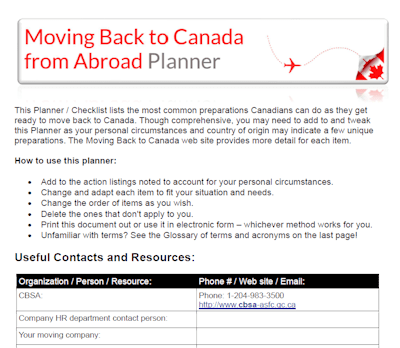 A ready-made and up-to-date planner of questions, considerations, and actions to take as you prepare for your move back to Canada, organized on a timeline approach. Save hours of work and stress of trying to piece everything together. A companion tool to the full content on this web site.
Now available for immediate download. In easily editable Microsoft Word format so you can customize it to meet your planning needs. Also in PDF format.
NEW! If you are in the U.S. and moving back to Canada quickly your purchase includes a new edition as well: "Moving back to Canada from the U.S. in 30 days or less", in Word and PDF formats.
Testimonials: "Your moving guides and checklists are unbelievably helpful - frankly I don't know what I would do without them. You have covered everything including many, many things I would not have thought of. Thank you!!!" - C.W. April 2022. "The list of tasks is very helpful as I’m a list person. Just love checking off the boxes!" and "I must say I truly appreciate having purchased your guide to moving back to Canada. While we are still a couple months away it has really helped me keep all the "balls in the air".
Bonus #1 ! Includes the guide: "Canada in 2026: 10 Insights to Empower Your New Life in Canada." Written by Paul Kurucz from his experience helping over 1,500 clients return to Canada, this guide will help you better understand the Canada you are coming back to!
Bonus #2 ! Includes the "Real Estate Selling and Moving Checklist" to help you prepare for your move back to Canada if you will be selling your house, townhouse, or condominium!
Purchase and Download now:
(PayPal, Visa, Mastercard, Amex)