
Moving Back to Canada
Resources for Expatriate Canadians returning to Canada after living in the U.S. or further abroad
Moving Back to Canada
Resources for Expatriate Canadians returning to Canada after living in the U.S. or further abroad

Moving Back to Canada
Resources for Expatriate Canadians returning to Canada after living in the U.S. or further abroad
Moving back to Canada can be Exciting!
Canada offers many wonderful benefits to those returning home after a long absence such as it feeling generally safe, you usually have good public services, there is more freedom than some places in the world, you can be close to family, see old friends, and of course, enjoy the beautiful Canadian nature - mountains, lakes, forests, rivers, and more.
However, challenges may arise if you are a citizen returning to live in Canada. You may have to contend with reverse culture shock. Or possibly first-time culture shock if your spouse and/or children have never lived in Canada before. The logistics of moving your home and setting up your new life can also be daunting - what to sell, what to take with you, how to ship your belongings, and many more considerations. Then there are real estate, investment, tax, and timing concerns. In response to these concerns new options often arise that can be hard to choose between. Moving back to Canada from the USA might not appear to be much of a challenge but there are surprising similarities to the considerations of those moving back to Canada from further afield, such as from the UK, Europe, Australia, Hong Kong, or the UAE.
23 years of supporting expatriate Canadians! This resource website was started in 2003 from my experiences returning back to Canada after living with my family for a short while in the U.S. and 6 years in the Middle East. Our youngest son was born in Dubai. To him we were in effect emigrating to Canada. For the rest of us it was a big move back to the land of taxes, rain and snow,...and of course fantastic geography, beautiful nature, a wide range of ways to create your ideal lifestyle, family, and much more.
Since starting this resource site, I have answered thousands of questions from Canadians getting ready to move home and have added the findings from all my work to my original reflections. Every year generous Canadians from all over the world contribute tips, tales, and suggestions from their own experiences of moving back to Canada, keeping this site up-to-date with practical advice. Our combined wish is that you have a confident and exciting move back to Canada!
If you find this site useful please "pay it forward" to those moving back to Canada in the future by sharing what you have learned. Please contact me with any thoughts, insights, and wisdom you can share!
Finally, everyone's situation and context is unique. Should you have questions you would like answered by in a professional and friendly manner I also offer professional support for your move back to Canada.
Welcome back to Canada! May your move be smooth, easy, and exciting!
Sincerely,
Paul Kurucz
We are in the news...

Leaving the U.S. to retire back to Canada? Some thoughts from Paul Kurucz and of a client are in this New York Times article:
read more.
And if you are planning to retire in Canada, check out the "Retiring in Canada" resource page on this site!
Latest News
Feeling uncertain?
These continue to be uncertain times for many Canadians living in the U.S. and around the world. If you are finding yourself in a time of major personal life change and feeling uncertain, overwhelmed, or simply in need of personal support for a decision about whether moving back makes sense for you and if yes, when and how a move back to Canada, I now offer caring, confidential, and safe Personal Life Change and Transition Support. Emotional intelligence included.
Professional Support
Professional support is available for your real estate, tax, move timing, investments, logistics, and lifestyle questions when planning your move back to Canada.
Moving Back to Canada Planner
Now available for immediate download!
A comprehensive companion planner and checklist for moving back to Canada now available for immediate download:

How to use these Resources
Consider moving back to Canada:
Plan your return to Canada:
The planning steps are arranged by the amount of time you have leading up to your move. It starts 18 months before you move back.
Moving sooner than 18 months? No problem! Just work through all the steps to be sure you are ready. Scroll up to see links to all the time-based planning steps...
Learn from others:
Canadians around the world contribute their wisdom to this site. (Thank you!) Throughout the content you will find their insightful stories, ideas for consideration, and useful tips.
Can you share your own wisdom to help other expat Canadians?
Find answers to your specific questions:
Tax, real estate, health care, country-specific, FAQ's, and much more!
Here are the links to specific topics where you will find answers to many of your questions!
Professional help for your move:
Moving back to Canada is a major life transition for most people. I offer professional guidance for questions specific to your unique context, help you make sense of your options, and help you disolve any uncertainty and overwhelm about moving back so you can feel clear and confident!
Professional Support for your move back to Canada!
Why move back to Canada?

This question is easy for some to answer, but not so easy for others.
Common reasons for moving back to Canada:
- Your job or contract overseas ends.
- Your employer moves you back.
- You are tired of living abroad and want the familiarity of Canada again, especially when you retire (see the Retire in Canada page of this site!)
- You want to live a "Canadian" lifestyle again.
- You have family and friends to return home to.
- You want to raise your children in a Canadian context.
- You have an elderly parent to take care of.
- You need access to the public health care system in Canada.
- You have just gone through a relationship breakup and want to retreat and regroup in Canada.
Very common challenges in the decision making process:
Sometimes, a decision to move back or to stay abroad is not an easy one. Here are a few of the common challenges in the decision making process:
"My husband/wife can't find a job here. I am fine, but they are not happy here."
"My parents are getting old and I want to come back to Canada to take care of them. But my spouse's job is here overseas, my children are settled and doing well, and we have our friends and support group here."
"I have never felt fully at home here. Everything is "fine", but it is not Canada and not the culture I grew up with. I want to go "home" to what I knew when we left Canada."
"I want to move home to Canada but my spouse is from here and doesn't want to leave his home, family, culture, and country to move to Canada."
I hear these same themes many times a year in my work with clients and from stories offered by Canadians living abroad. Challenges such as the ones quoted above can cause couples and families a lot of stress.
There is no easy solution for most people, but one thing you can do is to use the discomfort of the situation to learn as an individual, couple, and family about what is important to you at this point in time. Exploring what you want life to look and feel like is a healthy process, often leading to exciting clarity on where you want to be in the world.
NEW! Support is available! If you are feeling personally challenged at this time by changes happening in your life - whether they are positive or negative - I now offer life transition support. Caring, confidential, and private support to help you make sense of where you are at and how you might move forward with a return to Canada in a positive way. Emotional intelligence included at no charge. - Paul Kurucz
Some questions that might help:
- Why do you really want to move back to Canada right now?
- Are you running away from something or running to something in Canada?
- Where should you be right now for what you need to do in your life at this time?
Answering these questions in complete honesty (to yourself) will really help you understand what you want from life in Canada when you return. It may also help you decide if Canada is even the best place for you to move to right now!
To help you get started with your answers, here are some of the reasons people like being expatriates - why they like living away from their home country.
What will you miss from the expatriate lifestyle?
- Meeting amazing people
- Finally being away from home
- Having this once-in-a-life-time experience
- Realizing that things can be done differently
- Changing ourselves - yes we can
- Being out of our 'comfort zone'
- Realizing that not everything at 'home' is perfect
- Learning a new language properly
- Showing your visitors from home around your new hometown
- Being a font of knowledge on your home country
- Knowing how to cook differently ('Teach me to...')
- Being popular just because you're foreign (exotic) ('I loooove your accent')
- Becoming an absolute magnet to the opposite sex ('you're from LA? Wow!)
- Always having a conversation starter ('And where are you from?')
(Source: Linkedin, Trailing Spouse Network group,)
The ping-pong effect
My family and I experienced a peculiar situation and I have since heard from many people who have gone through it too. I call it the "ping pong effect". Here is how it happens:
You return to Canada and after a few months or a year find that life just isn't working out - you can't get a job you like, you don't fit in, your family doesn't fit in, you don't have a "tribe" here anymore, and/or you miss the international lifestyle.
So, you pack your bags and head off to another international assignment.
As of the writing of this, friends of ours are doing a "ping pong" back out of Canada, after spending a year finding that getting good work in their field in Canada is really a challenge.
We did the "ping pong" back out after 9 months in Canada and the U.S. and I almost cried the day I landed back overseas on my second gig. Going back overseas felt like going home.
Weird. But true.
Tanya explains how "wanderlust" took her family back abroad after moving back to Canada:
Before moving to the Middle East, my husband and I lived in Taiwan for 7 years. When we first arrived, we went to observe a teacher who was from Ottawa, our home city. We became fast friends and when we all moved back to Ottawa, we ended up buying townhouses right next to each other. Unfortunately (mostly for him) we have wanderlust and needed to travel and live abroad again! He takes every opportunity in the summer when we go back to visit to remind us of how we abandoned him!
(More insightful stories from returning Canadians are shared later in this section)
If you are not completely at peace with moving home to Canada but are making the move anyway because of the end of a contract that didn't get renewed, for example, consider a staged move back. I often advise my clients who are uncertain to consider a first stage of "wintering over" in Canada - a temporary move until they either find their "place" in Canada or decide to head back out again. Once they are clear on where they need to be next, they take another step in the return process. Don't make expensive decisions and final pronouncements unless you are really certain about moving back to Canada. Many of my clients have thanked me for this guidance! It allowed them to step through their return in a way that honoured who they were and what they needed at that time in their lives.
Not sure if a move back will be right for you?
Check out the "You moved back to Canada...and life is not working out well" resource page on this web site. It goes through a method for determining what went wrong and what you might do about it now that are you back in Canada.
While you are likely reading this before you return the resource may be helpful in determining if a move back is the best path foward at this time for you and your family.
Common profiles of returning Canadians
Here are 5 common profiles of Canadians moving back. I have seen these from long experience working with clients and from my own time living abroad. Please note that you may be an exception - many people are. If, however, you do find one that is close to your reality, it may help you have a more successful move back to Canada by clarifying your target state of mind, lifestyle, and goals.
A. "Ultra-organized". This person or couple knows exactly where they are moving to in Canada, they plan the whole move well, and they get what they want. Life tends to give you what you envision if you are laser-focused and very, very clear in your mind and heart. These returnees are generally happy when the move is over and their life is settled in Canada because they created their desired perfect lifestyle.
B. "Family move". Hope for a better future for their young children motivates this move. I have had many clients returning from the U.S. in 2019, 2020, and in 2021 for this reason. However, this also applies to families returning from all over the world and particularly from places that are in turmoil. Families with young children can generally create a great life in Canada because they "ground" their move in a foundation of family priorities and values, reflecting the life stage they are in. Note: Families with teenagers can find their move a bit more problematic simply due to the typically stronger need teenagers have of stability and peer bonding in those years.
C. "Career move". "Opportunity" and "timing" are the motivating factors for this returnee profile. Life presents an opportunity and it happens to be the right time to move back to Canada. Following an opportunity back to Canada results in a staged experience: First comes excitement, then reverse culture shock, and after a year or so a very positive life balance in Canada. Individuals and families alike experience symptoms of adjustment. What helps this group? A ton of careful consideration, planning, and personal support for themselves and each other after they arrive.
D. "Healthy Nomad". This individual or couple makes life happen through a combination of planning well, listening to their intuition, trusting things will work out, and being open to new experiences in a cheerful manner. This is a more "non-linear" return path but results in a life that delights them. Overall, this group is happiest in Canada the soonest because their cheerful "take-life-as-it-comes" attitude allows them to figure things out, find great people to connect with, adapt and grow personally, and create an meaningful life here. Hmmm...I bet this group would create an amazing life wherever they went in the world!
E. "A shot in the dark". Pushing away from something defines this group. Fear for their safety where they are, a divorce, a lost job, death of a spouse, etc. are reasons this group moves back to Canada, often to the locale they left or to where they have family living in Canada. This group sees Canada as "safe haven" and a place to retreat, rest, heal, and re-build their lives. Happiness for this group takes time as their move is not really about Canada but instead about ending one phase of their life and starting another. I honour the decisions people make to return to Canada when faced with real challenges in life. Canada is a great country to pause, re-group, heal, and prepare for your next steps in life.
Please share your thoughts on these profiles and your reason for moving back to help make this resource better! Thank you!
Why move back? Insightful stories from fellow Canadians:
Karin Q., generously sharing her experiences and where she finds herself after returning to Canada:
Hello, thank you for the informative site.
I'm a Toronto born woman visiting for two weeks near Toronto.
I admit I cried from relief reading this article...other people go through similar feelings? All mixed up inside and churning pros and cons around???
Now 39, wish I read this article when I was 20. Would have saved myself a lot of torment!
Visiting this week, I'm thinking what is important to me? What can I give, how and who to and where? Very hard questions.
I moved to The Netherlands in 2000, after I finished Uni in Toronto. Actually, six weeks after. This was for a variety of reasons, primarily running away from my Dutch born Mother's extreme mental health issues. (My father is Toronto born and raised). To add, living a life in the suburbs, getting away from people I thought I knew, being out of the potential rat race and not really wanting that 'good' house, car, job or having people close to me watch my progress in life were all reasons for seeking something more.
I never even once worried about finding myself with people who did not know me, and was almost proud to be 'new' or have that clout everywhere I went in Holland. Questions asked of me where not so much of where I was from but fresh questions about who I was. Loved it! And time with my Dutch family was great too. I got a great job at a European head office of a well-known American corporation.
It wasn't all good, and that's important to note. It's not easy when you start abroad, letting others help and support you with things you need to do that you think you should be able to handle. Mind you, the same could be said of returning to Canada...I should know!!! And as you go on, I've realized that the house, job and transportation still 'need' to happen somehow, and quickly, no matter where you are!
In 2007, I moved from my Dutch Uncle's house in Amsterdam, and a good job, now with a US clothing brand head office in Amsterdam, to a small village in North West of England, -------- for a guy. We had been to Canada together and enjoyed the same things. He was from ---------, worked in HR, loved gardening, was an only child, so very independent, everything seemed good. Then he went into his own business. I has okay jobs with marketing agencies and even managed an animal charity retail location working with awesome volunteers.
Despite my successes, I moved back to Canada in November 2015, after my Godmother, (she used to be in my life in my teens when things at home were not good and so now calls herself my Godmother) suggested it a year earlier. The economy in the UK was, honestly in a slump, my job with a charity paid very little, making ends meet was hard. --------, it turned out was not the marrying type, more long term but living separate as he looked after his parents at his childhood home.
I met a woman in her 80's in ---------- in 2014 who had grown up there, but moved with her husband to Ontario in the 1950's after they married. They raised two daughters who still live in Canada. She moved back with no friends and one brother in the -------- area. She told me once that her husband and her decided to retire in the UK, after he finished his career with CN Rail. Poor health kept him in Canada. Now on her own after his death a few years ago, she made the move on her own. A 'push' she said was her neighbour. Her neighbour asked how her husband was, as they had not seen him lately. He had been dead for thee months. She missed and really wanted what she had growing up. The familiarity of small-town Britain in the 40's. But it wasn't to be found. She now volunteers at a charity shop, and lives in a modern apartment complex.
Back to my story, where my decision to move back was helped when my Godmother said she would help support me. And I hadn't been 50+ years out of my birth country, only about 14.
Great I thought. I have lived overseas, I worked at awesome places, been travelling, know interesting people, now a promise of a good life in Canada. Maybe reconnect with my brother and his partner, and their three boys. Very awesome....
Not. With no experience of working in Canada, I was told my first week back at a job agency in Oakville, my job options in my field of business, Marketing, were far and few between. Start at the bottom. I received many thousands of dollars from my Godmother, but that went to near $0 in 8 months after looking for a job, buying a laptop, travelling around the Greater Toronto Area, rent to my brother-in-law for a room in their house for 6 months and deposit plus first month on a small studio apartment in Mississauga.
I found a job as a supervisor in a big box US chain store.
I was interviewed by Canada Immigration on two occasions as I stupidly did not realize or think (or want to think) to ask how to re-enter Canada after being away - and just literally asked for a renewal on a very expired Health Card....plus I was missing vital documents required to 'just pick up life' again. I don't know now what I expected, but it wasn't what I experienced. I needed a guarantor for EVERYTHING as I has no credit history in Canada. I was literally feeling like a broke criminal. No one was interested in my life over there, in the UK or Holland. I had even less contacts, no friends, an elderly Godmother making demands, and my brother's common law wife had her own life and friends and three boys, including twins with autism. Where was my head?
I left [Canada] with very little in two suitcases in 2017 back to --------. I cried for what seemed a week afterward back in the UK staying with --------'s parents. At 37, I felt I should be settled, married or something more than what I was. ------------ called a time out on our relationship. I found a job relatively quickly with a European Sports Retailer Head office as a Manager in Customer Care. Starting again is not easy. Brexit looms, as a dual citizen with Holland, what does that mean for me?...and coming into a work environment where almost everyone worked with someone in past roles with other companies in call centre work, not to mention the grey weather...lack of any Dutch or Canadian familiarities that bring contentment...even for a short period, it's stressful.
It's 2019, and I feel like I need to be back in Canada to help my Godmother as she is forgetful, in poor health. She is so very angry I left her in 2017 after her support. My dad's mom, 92, did not recognize me last week on a visit. But two years ago, in early 2017, she had driven me for lunch to a local restaurant! Should I be here to see her while she's with us?
I realized I could have stayed and made it in 2017, if I had just noted down this website’s suggestion of being honest with myself. What am I looking for? What can I accept and what is I can offer and where? How do I make what I want a reality...thinking with the head not heart is just denial. People moving back should never ever assume that experience, new exciting exotic people or travelling is a passport to a life back in Canada. Canada may seem familiar, but it too will have moved on.
And you still have to wake up, pay bills, taxes and get in 8 hours of work a day, thinking about dinner.
Gosh, what a mess. My 'Godmother' only retired to Canada in her late 40s after her life in Germany because her husband thought it would be a great thing to do. Now 81, she wants to go back to Germany as her husband died last year and she does not like Canada but she says finding a life back in Germany after 30 years would be hard. Her family in ------- has promised to help, but she is realistic that that promise may well be gone after a few months.
Do I want to be in a home at 90, if I'm here that long, and think, "Well, I should have been there for family..." or "Why didn't I just run off to a small village in Holland and do what I wanted in life?"
I love being different. I love being the one in the office who can correct people on things North American, or talk to the Dutch colleagues. But family and what I want are pulling me apart. If I could afford it, I'd be a year or two in Canada and a year or two elsewhere.
The novelty of people asking where in the world are you? wears off pretty fast!!
Thank you, Karin for generously sharing your truth with readers here. It will make a real difference to those in similar situations.
Cathy G., reflecting on the challenges and joys of living in Australia but wanting to come home to Canada:
I am a Canadian living in Australia since 2005 with my Australian husband. I constantly want to move back "home" to be close to my four adult children, and my mother who is 96. We are in our 60s now and seriously trying to work out how best to move there, especially worried about what to bring, what to leave, will we like it, how to sever ties here and get new ones there. I never realized I would need forms to return to Canada, and the forms to apply to sponsor my husband are daunting! It requires my salary amount, and of course I would not have created a salary again in Canada until after I get there.
Reading your site has been thought provoking and even though it has opened a whole can of worms, it is lucky that I have found your site, thank you for being there! I love Australia actually, and am totally nervous about moving back to the cold and rat race from our pristine forested land of 20 acres (purchased for less than a city lot in Canada) where we have just built a brand new house, with our own hands. We also have a very spoiled cat that we adore and who we are afraid won't survive physically or mentally being thrown in a cargo bay of a noisy airline.
It won't help me now, but my biggest tip is never go out of your way to get romantically involved with someone who lives in another country! One of you must always give up their way of life, you just can't be in two places at one time, sadly. If there is a way to do that, I would love to know how! Cheers!
Thank you, Cathy, for sharing your experience and suggestion!
Planning to move back to Canada to retire? Check out the "Retiring in Canada" resource page!
Tammy M., reflecting on the challenges of living abroad (and exploring if to return to Canada):
I want to thank you for this invaluable site! I am determining whether or not I should return back to Canada. After the initial vacation period overseas, I am finding myself without employment and missing my family. My husband however, has a job and direction and is really enjoying not having to work in the harsh Canadian climate.
I can honestly say it has been the most difficult time in my marriage. Living overseas has pushed to the forefront what each of us truly values in life: what we value in our relationship with each other, as well as, our immediate family.
It is an obvious question to ask, "Why do I want to move back to Canada?" However, it is difficult to come to a decision when you know the financial costs involved and the new dynamics you have in your relationships when you return after a few years or more.
Moving becomes a question of, What do I want to give up? Is this need to move back based on reality or what is being experienced in the immediate situation?
Back to why I am sending this . . . Thank you. your site is unscrambling questions that keep going round and round and it is enabling a path toward an informed decision. Thank you also to the contributors for sharing their experiences and pointing out various aspects of their move.
Thank you, Tammy, for sharing your experience!
The following story was shared with me by a Canadian who moved back recently. Due to the personal nature of this story, her name has been withheld at her request and identifying details modified to protect her family's privacy.
We had been living in the United States for 11 years when I knew I wanted to move back to BC. Our children only knew the American elementary school system; I knew I wanted our children to be back in the Canadian School system and have the choice to enter the French immersion program. But my husband did not want to approach his Company about the move because we had just received a visa extension when I presented the issue of moving back. My husband did not want to rock the boat with the Company because we would have one more year left on the visa and that was the agreement with his boss. Also, a huge issue would be the time difference between the offices.
I was certain that the time was going to be in the summer and consistently told my husband we needed to make the move for the sake of the children. I reminded him that we had moved there for his sake his career and now it was time to make the move back for the kids sake... it was important for me too that the boys would get some time in an elementary school setting to make new friends before entering the high school years. I kept telling my husband how important it is for the boys to develop new friendships that they could carry into their adulthoods back in Canada. It was important too that we knew we would keep in touch with the friends we had made in the states too. We feel blessed with the rich friendship experience.
When it became clear to me that my husband was in denial about how serious I was about moving back I insisted we have the discussion together. I basically told him I would go with the kids in the summer and we could set him up in a little apartment there - we could support his job that way... And I was serious. I think it was my strong foot down that finally made it clear to him that it was going to happen whether he was ready for it or not. So he got the nerve to tell his Company and it ended up being absolutely okay.
Now that we are back in BC, my husband spontaneously hugs me and says thank you for getting us back home!!!! AND the kids love their new school and are making friends easily and are keeping in touch with all their friends in the US! It's all good... phew.
These stories are indicative of the difficult decisions that dozens of families I have worked with faced when deciding whether to return to Canada or not. In all cases, there has been no "right" or "wrong" choice. Only one that helped each family move forward or one that held them back from the natural change, growth, and happiness they wanted.
Where do you need to be to help your family move forward?
And here is one more story, shared by E. Cernakova on the challenges of being back in Canada. Personal information has been replaced with ... to protect their privacy:
I moved to the GTA in September, after discovering that finding a job in the Ottawa Capital region was challenging, given my overseas work experience in the past 5 years. Getting security clearance was not an easy process, so I chose to return to the GTA where I had more contacts...
Early November I was hired ... on a 12 month contract... . It's kind of a "survival" job for now, which has allowed me to get settled in a shared flat (shocking what is happening with gentrification throughout the GTA and extreme rents) and slowly start to feel more settled in.
I am fortunate, and count my blessings with a great boss and a job that isn't too taxing and just covers the essential: rent, bus pass, food, storage costs... added benefits and pension... It's extremely challenging to be back here, with such high living expenses. But I am highly skilled, and believe I will be successful in finding opportunities to increase my overall income...
So I consider myself to still be "transitioning" back to life here in Canada. For expats like myself who were overseas alone (one income) and had debts to settle while overseas, it's not an easy thing to return with minimum savings. Sometimes we just have to leave - and I don't regret coming back to the GTA when I did as I have to continue working for at least 10-15 years; I felt I had to get back into the Canadian workforce.
My advice to all my friends still overseas, especially those who are older than I am and much closer to retirement, is to stay put and make as much money as they can where they are. Bring back as much savings as you can, as it's insanely expensive in NA and costs a LOT to return. Incomes have not kept up to par with the cost of living. I feel as if some companies think they are still operating in the 1990s! There are days when I think: it's just as expensive to buy groceries, rent a flat etc. here as it is in the Gulf but I am making 50% less. Ouch.
Home | Share your story | Get help - Professional Support for your planning and return to Canada
Preparations you can do ahead of time:
Starting 18 months ahead of your return to Canada

I. Make sure everyone in your family is legally allowed to live and work in Canada
- Sponsor your spouse to become a Canadian Permanent Resident. Many Canadians marry abroad. When they want to return to Canada they must sponsor their spouse to become a Permanent Resident (PR). This means their spouse can live, work, and access health care in Canada. At the time of the writing of this, the officially stated processing time for sponsoring spouses was 12 months. This is the time you have to wait after you apply. There is lots of work to be done to prepare the application, which is why this step is noted to begin at 18 months before your target return date.
April 2024 update: Processing of spousal sponsorship PR applications are still shown on the Immigration Canada web site as being a long time: 12+ months. However, most applications are now being processed in 6-9 months, based on what my clients are reporting as a reality at this time, particularly if you live in the U.S. You can still start the process well ahead of time as you have a large window of time to move after a PR is approved. More details... - If you have children born abroad to you, a Canadian citizen who was born in Canada (an important requirement), your children are automatically Canadian citizens. Hurray! However, you must get the Canadian government to recognize this. The process can take some time - 12+ months I am hearing from clients. Get this done now. And once approved you can apply for their passports.
Why get their passports immediately after approval? Because as dual-citizens they will need a passport to come into Canada. And their passports will be useful as a form of primary identification when they register for health care and schooling in Canada.
Check out the Immigration: Bringing a foreign-born spouse and children to Canada resource page on this site for more indepth coverage of this topic!
II. Planning on buying real estate in Canada?
If you plan on buying real estate in Canada for when you move back, this is the time to begin exploring where you want to live and the state of the real estate in that area. In the "What to do 12 months ahead" section below there is a lot more detail on considerations for buying real estate in Canada. As well, there is a dedicated Real Estate in Canada resource page on this site.
III. Create an up-to-date Last Will and Testament
Things happen. Having a current Will that will cover you before, during, and after your return to Canada is simply wise.
I have shared some considerations as to why it makes sense to create a Canadian Will and have partnered with Canadian Legal Wills to offer you an easy, inexpensive online Will creation tool, regardless of where you are in the world and where you will be moving back to in Canada:
Will planning and to create a Canadian expatriate Last Will and Testament online
IV. Register to access your government benefits and tax information online
Are you registered with the Canadian Government to have online access your CPP, OAS, tax return filings, RRSP, TFSA, etc information?
If not, register now so you can see where you stand from when you left Canada. This may help you feel more confident in preparing for your move, particularly if you will be retiring in Canada now or in a few years from now. But for everyone young or old, the information available online is super useful, such as understanding how much RRSP and TFSA contribution room you will have available when you arrive back, which can help with tax savings in the first year or two you are back in Canada.
Note: If your SIN (Social Insurance Number) has been made dormant because you have lived outside of Canada for 5+ years, you will have to get it re-activated by an in-person visit to a Service Canada office when you visit Canada next or by phoning them and getting a re-activation form done and sent in.
Apply here to access your information online:
My Service Canada Account
Another Note: I heard from a recently returned client in 2023 that she could not create a CRA online account because she had not filed tax returns in the last two years in Canada. I don't know if this same rule applies to a Service Canada online account but if you find you can't create this online account you can still phone Service Canada or visit a Service Canada office to get the information you need on retirement benefits, for example.
Raymond M. shares his experience in 2023 of being able to open a Service Canada account after a few steps [2024 update: What is noted below has largely been made easier. You can now take an SIN out of dormancy quite easily online or in a 5 minute visit to a Service Canada office anywhere in Canada]:
"You mentioned another client not being able to set up a My Service Canada account due to not filling taxes for 2 years. This is mostly true. I could not set up mine either (living in the US for 25 years). After hours on the phone, I was advised that my SIN had gone dormant since it had not been used for 5 years (but nobody could give me an exact date). I had to wake up my dormant account which would have taken a lot of time/effort from the US and took 10 minutes in person. I had to apply for a new SIN which reissued my old number back to me. I then had to wait several days for that info to cycle thru the system. I was then able to open an online account. Thought you might find this information useful."
Preparations you can do ahead of time:
Starting 1 year ahead of your return to Canada

I. A practical action: Create a physical binder or secure folder for your move back.
Moving back to Canada initiates a very busy and complicated time in your life. Over the next year you can make life easier for yourself if you are particularly well organized. Bill Rose shares his wisdom for being organized and feeling lower stress as a result:
One thing that helped immeasurably was we made a single binder, tabbed with important sections like "banking", "possessions", "Cars", "insurance", etc. and carried that entire binder with us whenever we went somewhere or met with an official. Having a clearly organized binder, with ALL your documents at your finger tips was a huge help. It is stressful doing all these needed steps, and having it organized kept us from freaking out. I'm positive the officials we met with were reassured that we were organized, knew what we were doing, and had everything we needed. Of course the binder NEVER left our sight - we treated it like our passports - essential and irreplaceable!
II. Decide where you wish to settle in Canada.
- If you already own a home in Canada, have a job to come back to, or wish to live near relatives in Canada then this decision may be a moot point for you.
- If, however, you are not set on a province, city, or region to go to when you move back, the question of where to settle in Canada becomes a very important one. Why? Because you have changed in your overseas experience. You may find most Canadians charmingly provincial at first.
The charm wears off fast.
Soon you may find yourselves wondering when you can go back overseas to be with more worldly folks. Really. It won't take long to feel this way! Many people have noted this same feeling to me over the years.
To help make the transition easier, consider what your values, interests, and goals are. Then choose cities and regions of Canada that fit these and that suit your family. Some examples:
If you feel that you want a liberal, worldly social group, consider Ottawa, Montreal, Vancouver, Toronto, etc.
If you wish for a more conservative social context, consider London, ON, Halifax, Edmonton, or a smaller center in a more traditionally-thinking region.
If you want nature and outdoors activities, BC tops the list (of course, I am biased because I live there!)
The most important thing to remember is that you are different because of your overseas experiences. Canadians haven't changed. You probably no longer fit into your old life in Canada! You will have to create a new fit. Prepare ahead and you will thank yourself later when you more easily navigate the "reverse culture shock" almost all Canadians experience when they return. - Jobs and careers are an important consideration for some returning Canadians. If getting a job is a very high priority for you, then some simple homework will tell you where the best job markets are in Canada for your skill-set and experience. In general, Toronto is almost always a good place to find work as it is so large. And other places in Ontario such as Hamilton, Kitchener/Waterloo, and Ottawa have abundant sector-specific work opportunities. British Columbia is also booming: Vancouver, Victoria (the lowest rate of unemployment in Canada in 2018 and 2019!), and Kelowna all have numerous opportunities. Finally, Montreal has some great work opportunities in specific sectors, particularly if you are fluently bi-lingual.
See the Career reource page on this site for much more on returning to Canada and getting a job here.
Note: I cannot stress enough the number of job opportunities that are available in technology: Software, automation, robotics, AI, data mining, fintech, computer graphics, etc. Canada is transforming economically from being primarily "hewers of wood and drawers of water" to something quite different: A country who derives much of its wealth from very high value work. If you are employed in one of these fields you likely already know this. If you are not in one of these fields and have the opportunity to explore tech and tech-related jobs and careers? Go for it. They are a bright part of Canada's future.
III. Buy a residence ahead of time (if you can afford to)...
- ...but consider renting it out before you arrive. Owning a house may jeopardize your non-resident status with the CRA (Canada Revenue Agency) if it appears you are "living" there. This would be yucky if you have been enjoying lower or non-existent taxes in your off-shore country! So, rent it out at arms-length (not to a family member), set it up as a "vacation property", or keep it fully empty as an "investment" to ensure you are not deemed resident in Canada.
- Tip: Buy a house in December or January: The best time for buyers. You can quite often get a great deal.
- Having a house ready for you and your family when you arrive means you can get excited about where you are going to be living in Canada. You will have a mailing address for forwarding your mail when you return. You will have a place to send your household goods when you move back. And you will have a place for your family to land when you arrive (lower costs - see finances below). All very helpful details.
- DON'T buy a house if you are unsure of where the best place to settle in Canada is for you. Rent one instead, giving yourself the freedom to figure out what feels best. Sometimes "what comes next" in life is not perfectly clear and we have to wait until it does become clear. If you are in such a situation, don't buy a home now. Rent instead for 3 months, 6 months, or longer first.
See the Buying Real Estate in Canada resource page for a deep dive into the process of buying real estate in Canada for your move back or as an investment for the future if you don't plan to return to Canada for awhile.
Paul Devoy, on renting a place for some time in Canada before buying a home here:
We will list and sell our current home and cash out so we have plenty of cash to be used for a cash deal on the Canadian property. Since we don't know specifically where we want to settle down within Southern Ontario we are renting a nice furnished home from Oct 2020 thru Mar 2021 and intend to use that time to really figure it all out while living in the Canadian environment again...We haven't really considered the aspect about maybe not fitting in any longer but it now concerns us so the rental suddenly looks brilliant and we're happy to see you recommend that strategy. We expect this to be a stressful time in our lives once we sell our home we will no longer have a fixed address and only a 6 month lease. But I keep telling myself this is a wonderful opportunity to take advantage of that freedom and go wherever we want for the first time in our lives.
Thank you, Paul, for sharing your plans and thoughtful approach!
R.L. on finding a place to live:
I think for us one of the most difficult things has been finding appropriate housing for our family. We have never lived in BC so searching for an apartment/condo to rent near Vancouver has been daunting. One thing that I am glad someone told us was that we should look at getting "transitional" housing rather than signing a one-year lease. This proved to be great advice! Since we had a time frame in which we had to find a place to live, we ended up in a basement suite in Burnaby on a month-to-month lease. The location was great...the suite was not. However, it did give us time to start looking around and to determine what area would be best for us to live in. It was also SO much easier to look for a place when we were already in the general area. I had been doing the Craigslist thing from Bangkok but, in a city like Vancouver, you really need to jump on housing when it shows up. If it's a good place, it won't be available for very long. Eventually, we found a great place, at a fair price in an area we felt suited us.
Thank you, R.L., for sharing your experience!
IV. Prepare your finances.
If you wish to leave money off-shore, prepare for that now. Open appropriate accounts, make appropriate investments, choose your money's geographic domicile. Hint: Often it makes sense to talk to a few different people who do this - other long-time expatriates, a professional financial adviser who handles international banking and investments, an international tax accountant, etc.
Keeping clear track of your finances while overseas and when returning is recommended, particularly if you have to account for your income as a salesperson, a small business owner, or as an independent contractor.
Canada is expensive if you have to live in short-term accommodations, rent a car, eat out a lot, etc. when you move back:
- Budget for 4-5 thousand dollars a month (yes, a month) for a typical family to live in short-term furnished accommodations, rent a car, eat at restaurants, and buy things needed for your new life.
- The sooner you can get settled in your own accommodation and buy a car, the sooner you will stop the hemorrhaging of your bank account
- Assume that it will take a minimum of 2 months to get settled and 4 months to get really settled. That's right: Count on up to C$20,000 to just get settled (family of 4 example) in a new place in Canada.
- Staying with family members sounds like a good idea, but if your family has enlarged, or if your kids have gotten a lot older in the years overseas, staying with family will get very difficult very fast. Your parents have gotten a lot older during your years overseas. Your other family members think you are rich because you had an expat lifestyle. They won't be happy with you camping in their basement. After all, since you are rich, why don't you just stay in a hotel?
- Don't mess up your early exciting experience in Canada: Stay in your own separate, private accommodations when you arrive back. You will thank yourself later and so will your family members!
Corrine R., who moved to ON from Australia:
Also, get people to get an address asap and internet as we needed an address to get access to school, ohip, etc. we spent 100's of dollars sitting in cafe's just to get free wifi to apartment hunt and job hunt, etc.
I also had a dormant RBC bank account that I reactivated and started using my debit card on. After 2 months of spending like crazy, I realized I racked up over 100 dollars in bank charges. Get onto a bank account that allows unlimited transactions!!
Helen H., who moved to Burlington, ON:
You were also VERY right when you mentioned that I would hemorrhage money! The price of a used car was clearly more than I had budgeted for. Had I realized that, I would have shopped for this a year before I moved back. One pleasant surprise was that groceries were cheaper and fresher than what I was used to in Florida! Go Canada! So glad to be back home.
Credit History
If you have been out of Canada for many years and have severed all important ties (per CRA stipulations to ensure non-residency), you have little or no current credit history. For those moving back from the U.S. in particular, this can worrisome as there is a lot of stress around credit ratings in the U.S. Note: Credit ratings in Canada are of value and importance, but less so than in the U.S. The lack of a recent credit history situation in Canada has two aspects: "It doesn't matter" and "It can be frustrating". Let's look at the first aspect: "It doesn't matter":
A quote from a client who moved back to Toronto in 2019:
"Was able to secure a credit card with a $9000 limit...not sure how that happened without any credit history"
Yes, if you have money on deposit with a bank or credit union in Canada, you can normally arrange a credit card, car loan, and even a mortgage now. There may be a few frustrations (see below), but the lack of a current credit history does not stop you from setting up your life again! It just may means that you have to shop around and there may be a few road bumps along the way in the first few months.
The second aspect: "It can be frustrating"
One client in 2019 sent $2 million to Canada as part of their move and was shocked when both their bank and utility companies wanted a secured deposit to set up credit cards and utility services. This did not feel very good. But did it actually form a barrier to getting set up? No. It did not. Just that it may be hard on one's ego if you have equated money to "trustworthiness" and "money allows me to avoid rules and processes". Yes, "money speaks" in the U.S. and many parts of the world, including in Canada. But Canada is also a somewhat process-oriented country. These processes, while at times frustrating to what we want to accomplish, are also what helps keep the country running smoothly and safely - the exact reasons many people want to move back!
Be ready to face the following:
- Banks and credit unions may tell you "Oh, no credit history is OK. At least it is not negative!" In my experience, this is not true. A lack of recent Canadian credit history is the same or worse than negative credit to banks. You have not been "in the system", and therefore, you are an unknown variable. As such, are a risk. As noted above you may have to work harder and shop around to secure a credit card, loan, or mortgage. And of importance: Bank tellers and loan officers at most banks are not the same as in the past! Most are now younger people who are trained to follow what the computer tells them and to sell you new "products" the bank wants to push. Remember the experienced bank teller or loan officer of even 10 years ago? They are mostly either gone or have moved to another job in the bank. So be ready to shop around and work a bit harder to get the financial tools, services, and loans you need now when you move back!
- The only normal way to easily get loans, mortgages and credit cards is to have a job - even if you have $2 million cash in the bank! The Canadian financial lending system is based on lending against income earnings through provable normal sounding employers - and not against you or your assets.
Suggestion: There is a burgeoning mortgage market for non-traditional, exceptional folks (like you!) The key person in this market is the mortgage broker, who is a very useful person to get to know. If you are planning on getting a mortgage when you arrive back in Canada, find a good mortgage broker. Skip banks and credit unions completely as your first contact. Good mortgage brokers can get you a mortgage anywhere in the province you are in, so they don't need to be in exact location where you are.
For more detail on getting a mortgage and mortgage brokers, see the Buying Real Estate in Canada page on this site.
Credit Cards
A newer set of credit card options have emerged, with good news for returning Canadians. CIBC, for example, offers "Newcomer" and "secured" credit card options. These allow you to quickly get a credit card, which is an essential tool for getting things done in Canada online, for travel bookings, and for securing rentals:
https://www.cibc.com/ca/credit-cards/building-credit.html
The Royal Bank offers a full "Newcomer" banking and credit package which returning Canadians cannot access. I phoned them and after hearing that newcomers excludes
returning Canadians, asked them how this group can access RBC services. They were clear that services for returning Canadians are handled at the branch level and credit would be offered only at "branch discretion". Further "branch managers would have to go above and beyond to research returning Canadian credit and try to get credit history from the other country." I offer this story only as an illustration of the patchwork of possibilities. Returning Canadians are on few people's radar.
(Note: I am not affiliated with CIBC or The Royal Bank of Canada in any way. These two are noted only as examples. Please check with your preferred bank(s) for options they offer.)
A review of secured credit card options in Canada:
https://www.lifeoncredit.ca/top-6-secured-credit-cards-for-canadians/
In any case, check with your preferred financial institution to see if they offer a newcomer or secured credit card option, which will allow you to get a card quickly and begin building credit.
Some other options to consider:
- Keep your overseas bank account and credit card. Leave some cash in the account to allow you to use your credit cards for 6 months or more, until you get credit re-established and your new credit cards in Canada.
- Get a job. Any job that pays a decent amount and is with an organization that is "normal" sounding. Then load up on your financial needs and tools. Then you can quit the job, if it is not suiting you. Once you are in the game and a customer, you have all the tools you need. The hard part is getting to play in the game in the first place.
- Keep up a relationship with a person of influence in a financial institution in Canada. A friend or family member in a financial institution can make the "no credit" problem disappear - after all, they personally know you went overseas.
More on this topic: Check out the credit rating FAQ for more credit history and credit rating considerations.
V. Prepare your children for the change by discussing it with them early, openly, and fully.
This is a double-edged sword: On one hand it will help with planning. On the other, it will mean that the last year and the last few months in particular will go by slowly. It may mess up friendships a bit for them. However, it is my philosophy (yours may be different) that children need to be part of major family decisions. By being open about future plans and keeping them more or less fully up to date on these plans, your children will be able to actively prepare mentally. Not telling them until much closer to the move date will shock them and could make them feel helpless, stressed, and overwhelmed. You will be the one they take their frustration and insecurities out on as a result!
I have personally seen the effects on teenagers, particularly, who were not kept up to date and included in family decision making. Huge resentments built up over time towards the parents when a girlfriend had to be left, for example, without adequate preparation and support for their teen by the parents.
Some specific things you can discuss:
- Prepare them for the schools they may be going to. If you plan to home-school in Canada, find out what the home schooling "climate" is like in the area you are going to live.
- Discuss the benefits of your move home. Benefits most often include time with Grandma and Grandpa, shows/concerts/events, access to Canadian sports, outdoor activities they might not have had access to, a common language, freedoms and rights, high speed internet, lots of new potential friends, etc.
- Get them ready for what you will and won't be taking back to Canada with you. Furniture, toys, souvenirs, etc. Identify which toys are touchstones for them to feel secure and safe with. Have one or two of these items with them through your final months abroad and then pack them for the airplane ride, too, so they are close and handy.
VI. Pets
Pets! Britain used to be notorious for not letting pets into the country without a 6 month quarantine. If you have owned pets for a long time, this is no news to you if you have lived overseas. That rule has changed recently. Now Brits can bring in pets from certain countries (in the EU) with a vet's sign-off regarding rabies, etc. We knew people who would go to live in Europe for several months on their way to Britain just to get a vet's approval for their pets so they wouldn't have to be quarantined.
What about Canada? If you own a pet, bringing it to Canada is far less onerous. Only a current rabies vaccination certificate from a legally licensed veterinarian is required for bringing in a dog or cat.
For more exotic pets, check with the Canadian Government's Food Inspection Agency for the latest rules.
Canadian Food Inspection Agency.
Flying with pets
Flying with your pets is a challenging process. Some of my Australian clients have found out that airlines there won't allow pets to accompany you on the plane. Even after appealing to government, who said it was fine, the airlines continue to point to the government as the reason they can't allow this. What to do? A family there was quoted $3000 each for their two pet rabbits to be moved to Canada by professional pet movers in Australia. Another client chose to simply remain in Australia because she couldn't take her elderly cat with her.
If you are planning on returning with your pets from a country other than the U.S. (from which it is easy to drive them across the border) please research your options now for flying your pets to Canada.
A client, flying her dogs from Singapore to Canada:
I am in the process of the getting the rabies shots for the animals and two will be going cargo and one in cabin with me. Their reservations with the airline have been confirmed. Animal relocation can be crazy expensive and hence why so many are given up. Going as excess baggage is definitely huge savings as is not using an agent which is possible going into Canada due to the lesser regulations required.
VII. Children's Vaccinations
Children's vaccinations are another issue of concern to some parents. Every country in the world has different policies on vaccinations. Many mandate such vaccinations. And each country has a different brew they give to children at different times. At birth, for example, my son was given a TB shot. For the rest of his life he will test positive for TB because of this. However, there was a significant risk that we would be exposed to TB in the country we lived in and those we traveled to, so this was a balanced risk for us.
Canada does not require vaccinations at birth nor as a condition for entry for returning Canadians. However, expect that some public schools may require them on entrance. Can you object and be excused from this? If you do not want your children vaccinated, yes, you still can be free to not have vaccinations, depending on the school or area you are moving to. No-one likes playing games with important things you believe strongly in, but just as most people find in other parts of the world, there is more than one way to a goal. Sometimes you have to "work the system" a bit to get what you want in an imperfect world.
Thanks to a Canadian in Australia for suggesting pets and vaccinations for addition to this document!
To learn about how the Canadian health care system works, particularly in contrast to that of the U.S., please see the Health Care in Canada page.
VIII. Criminal Record Checks
Criminal record checks are a pain when done from overseas. Laura Walker moving back from the UK had to get a Canadian check done from there for a job in Canada and found it took 6 months from overseas but could have taken 48 hours from within Canada. If you need a criminal record check done for a new job in Canada that you will start upon arrival, getting a record checked in Canada upon arrival or on the last visit before you arrive home would make sense.
And if you need a record check in Canada from the country you are leaving, be sure to get one done before you leave!
Thank you Laura for this information!
Home | Get help - Professional Support
Preparations you can do ahead of time:
Starting 6 months ahead of your return to Canada
Jack Novak, a Canadian overseas, posed many interesting questions around the following central theme:
"Keep your goods and ship them or sell them and travel light?""
Jack wondered if people were happier taking a container of their possessions, for example, and shipping them back to Canada when they return, or were happier selling and going originally in suitcases alone.
I (Paul Kurucz, the author of this site) did it both ways. When I first went overseas my boss there said "Sell everything and bring only suitcases!" We did just that and unfortunately, regretted doing so...sort of. We were expecting our second child on the way overseas and having a container load of books, toys, and baby equipment, furniture, etc. would have really helped. We did get a generous furniture allowance, but in the end it would have been better, perhaps, given our particular point in family life, to have our "stuff" with us.
On the other hand, we had the opportunity to spend time experiencing our new country of residence without the emotional baggage, habits, and patterns that would have come with the household stuff we would have moved abroad with us. So we definitely benefited from the adventure of moving our life in 6 suitcases.
Your point in life is important, I think: My boss was in his 50's, had no children, and loved to travel with his wife. To them, moving meant traveling light and enjoying the freedom of their point in life. So my boss' first advice made sense...from their perspective.
We did a second tour overseas and this time sent a container and returned to Canada with one some years later. Great idea! We loaded up on cool stuff you can't get in Canada (art, rugs, furniture, etc.) on the way back because once your container is paid for, you can load it up to the very top with stuff at basically the same flat rate cost as 1/2 empty.
In summary, a few good questions you might consider:
- Where are you in life? Do you need your stuff for what you want to do now and for the next few years?
- Do you have a lot of emotional attachments to your stuff? How might this affect your experience after arriving back in Canada?
- What is the cost of shipping versus buying new stuff when you arrive back in Canada?
- What do you want your life to look like when back in Canada? A house stuffed full of belongings might not be an attractive way to start your "new" life back in Canada. On the other hand, an empty house that you must furnish from scratch might not be either!
Please comment on your thoughts and experiences on this question to add to this site! (contact Paul) Thank you!
Things to do starting around 6 months ahead of your move:
I. Find out how people from your part of the world move their household goods ("HHG") back to Canada.
Ask around with friends, your employer and fellow employees, and online via discussion boards.
Research moving companies and services:
There are several shipping options available to you:
- Go home with suitcases only:
- Pluses: No shipping costs, ready to move anywhere in Canada, flexibility, traveling light.
- Minuses: You will miss your "stuff" very quickly, costs in Canada for buying all your furniture, kitchen stuff, etc. are extremely high (remember HST/GST and PST?).
- Ship a bunch of boxes/crates home by air freight:
- Pluses: Stuff gets there fast, stuff is secure, you can pick up your stuff from your nearby airport.
- Minuses: More expensive, limited by size and weight limits, gets there too quickly - a problem if you don't already have accommodation lined up.
- Ship a bunch of boxes/crates home by sea freight or "Pod" (U.S. only).
- Pluses: Inexpensive, gets there more slowly (if you need time to get settled, this may be a good thing).
- Minuses: Less secure - your cargo gets bunched with others - it may be more susceptible to theft and damage than if it is in a sea container that you lock and unlock. That said, shipping companies make their living by ensuring cargo gets safely to its destination, so a trustworthy company that gets recommended to you can be very reliable. "Pod" shipping from the U.S.? A mixed security picture, but I have had no reports of problems from clients who used this method.
- Ship a 20' or 40' container by sea freight.
- Pluses: You lock it with your own personal padlock at the end of it being packed - you unlock when it arrives in Canada - very secure, a fixed and large amount of space, little or no damage if you are involved in packing it (or have it professionally packed), the opportunity to ship home larger furniture, you have your full household ready to go when it arrives (you don't have to buy much in Canada for your new house - big savings)
- Minus: Expensive (thousands of dollars) to rent a container (but may be totally offset by savings of not having to buy new furniture in Canada), takes up to 6 weeks to get to Canada.
Learn all the "ins and outs" of the moving business:
- If you can pack all your possessions, you will save thousands of dollars. Moving companies make most of their profits on the packing phase and on insurance. Pack your own and you will see sad faces from the moving company sales representative.
Some moving companies won't do business with you if you want self-pack. They will give you serious-sounding, but ridiculous, reasons why they must do the packing. Don't listen to them. Find a moving company who will let you pack if you want to save lots of money. - You may be able to handle air freighting or container shipping by yourself. Or not, if you live in a part of the world where corruption is rampant.
- Never leave for Canada until you have all the paperwork from the shipper in hand. Never fly out with the words "I will send it to you soon!" ringing in your ears. Leave with the original shipping manifest and bill of lading in hand. Canada Customs must have this when you arrive if you want to clear your goods through customs!
- Insurance on your container's goods is likely a scam. Many people who pay it and then try to claim for goods that got damaged in transit never get paid out. Or get paid out a pittance. The contract is packed with exceptions in fine print. If you have some extremely expensive, irreplaceable items then insure them individually and professionally and ship them by air freight. Otherwise, skip the 2, 3 or 4% insurance charges the moving company wants you to pay. The ship won't drop your container overboard. Your stuff will get there (particularly if you use the container shipping method).
R.L.'s experience moving her family back to Canada from Bangkok to Vancouver:
I wanted to fill you in a bit on our experience of shipping our goods from Bangkok to Vancouver as you provided so many helpful tips for us (thank you SO much)! Actually, the shipping of our household goods ended up being one of the areas that went the smoothest in our international move! We used a shipping company that a friend recommended (and she had had a friend recommend them to her!) and they were superb. Also, their agent on the Vancouver end was excellent as well. (If anyone visits your website and wants a recommendation for a shipping company in Bangkok, I'd HIGHLY recommend CargoPort Thailand. We dealt with a gentleman named Tony who was brilliant. Their web site is www.cargoportthailand.com).
One thing that did catch us a bit off guard was that Tony mentioned they would have to look in each box that we had packed (I guess to make sure we were in fact only shipping household goods). I panicked a bit (since we had done our own packing and the boxes were VERY tightly packed and I didn't want them being totally unpacked) but he simply looked in the top of each box. It was good that we knew ahead of time though so that we didn't tape up the boxes too tightly! I also had prepared a list of the goods we had so they used that as the packing list.
Thank you, R.L., for sharing your experience!
A cautionary experience: I was contacted by someone who did not have a good experience with a shipping company. Here is their story and my suggestions:
(Names of the individual and the shipping company withheld as I cannot confirm both sides of the story)
"Hi, we have been scammed and robbed by ---------------- relocation company. This a Canadian company that "services" many cities in the world: https://-----------------
We had to pay over 10,000 USD to be able to recover our things because this had our stuff kidnapped, after paying them us over 10,000 USD (of a 7500 USD quote). Therefore a service that had to be less than 8000 USD, ended on over $20,000 USD.
This people have scammed and robbed people for years, there are many sites telling horrible stories about them (unfortunately I did not read them before making business with them).
I do think it is very important to caution everyone who reads your web page of the wrongful activities of this company.
We are currently talking to lawyers and insurance company as most our things arrived very damaged and a Sony HD 60" flat screen arrived totally destroyed, so we haven't published our story, but here are some links [links withheld] on how people have been scammed by this people.
Please let us know if we can publish our story in you site and what is the proper manner to do so.
We really think consumers should be warned!!!"
My suggestions from the above experience:
Really research and learn about the moving industry in the country you are leaving. Here's how to lower your risk:
- Check with other people who have used moving companies where you are now living. Communicate directly with them about their experiences. You can find these people by asking around about who arrived recently or who left the country recently.
- Which moving company does your local Canadian or other country Consulate/Embassy use to move their employees in and out of the country you are in? Wouldn't it make sense that they would use a trusted moving company?
- Which moving companies do large corporations, NGO's, large international charities, etc. use to move their employees in and out of the country you are in? Same logic: These organizations will know the best moving companies.
- Consider air-cargo. We moved once by using only air cargo - selling all our big belongings. Air cargo was:
- ultra-fast.
- cheaper than I thought.
- you pack and unpack your own goods, saving money and controlling the packing quality.
- major airlines are generally very professional about air cargo in all respects.
- you don't generally need middle-men
- the process was much less hassle in all respects than container or LTL moving.
- Use the internet to really check your chosen moving company, particularly if you have any concerns after considering the above suggestions.
In summary, I don't advocate at any point in life to live in fear. Living abroad and returning to Canada should be exciting and joyful. Rather than fearing what could go wrong, or alternatively just throwing yourself at the mercy of the first moving company that has a sweet-talking salesperson, do some research through other people in your personal network (if you don't have this network, develop it!), check in with your instincts, and if conflicted or worried, consider a different approach to the move (a different company or method).
II. Book your moving/shipping company:
- Get a firm price quote.
- Build a clear and professional relationship with your mover.
Hint: One of the things I discovered about being successful in life is that it is not the quality and quantity of what you know that is important, but how good your questions are. Part of building a clear and professional relationship with a mover is asking lots of good questions. If the mover can answer them well, you have some confidence in their abilities. They also come to know that you are a customer who they need to treat professionally. If you get back from your questions:
"Yes, yes! We take care of all that. Just leave it to us!"
This can mean a range possible things, from "they really know their stuff" to "eeekkkk - my container went to the Ukraine by mistake?!" In either case, I suggest asking lots of questions and insisting on clear and full answers, particularly in the context of your moving company. I found out lots of things I needed to be prepared for, and that made my life a lot easier, by asking lots of questions. - Make sure he/she knows that you will be talking to many fellow expats about your experience after you move.
- A note on planning on the arrival time of your belongings: Household goods that proceed you may be a problem as you are not in Canada ahead of time to clear them. And you may be deemed resident from the point they arrive in time by CRA. Which means you might pay tax on your final earnings overseas! Be careful to try to have your belongings arrive at the same time you land in Canada or after you arrive.
This is not an absolute "must", but I am writing this from the perspective of creating the "cleanest" and easiest return possible.
John Morrison, a Canadian who moved back from the U.S. suggests:
Alternatives for reducing moving costs, for those moving from US or possibly Mexico back to Canada.
Consider these ways of reducing moving costs:
- if you have a car, purchase a trailer for it and self drive back
- if you don't have a car or any large items to move back e.g. appliances, then consider mailing your items using the US mail to a town just the other side of the border. US mail lets you send domestic mail, up to 70lb in weight for each item. Length plus width plus height of each item must be less than 130". Cost is approximately $52 per item close to these maximums. So if you had 20 boxes close to these maximums that would be $1000. Compare that to $1500 for base rental of a small 1 way truck, before buying gas and other moving costs. You then rent a truck from your new town in Canada for the day, drive down and pick up your goods from across the border. At least, this is my plan
Thank you for your site - got me thinking through my move back from the US!
Thank you, John, for sharing your practical suggestions!
Yvonne Berglund:
I found your website to be invaluable when planning my move back to Canada. I lived in San Diego, CA for 35+ years and wanted to return to Canada. The organization of the website spelled out each step very clearly. The unknowns of my return were answered. I was most impressed with the information given about the selection of a moving company. I attribute this very successful part of my return to the articles that helped me chose a moving company that not only provided information about packing but also assigned a coordinator who referred me to a contact in Canada to assist with the border crossing details. Everything went smoothly with this aspect due to the suggestions concerning the preparation of the necessary paperwork prior to reaching the border. I cannot stress enough the importance of planning. Your site supported the tips provided with real life experiences that prepared me for all aspects of this move.
Thank you again.
Thank you, Yvonne, for sharing your experience!
III. Sell off anything that will be hard to sell near the time of your departure.
This can include special sports/recreation items like scuba gear, expensive furniture, or expensive vehicles for which you would take a loss if you sold it in a rush in the last month before you leave.
Many people sell their cars at the last minute before they get on the airplane for Canada. Car dealers overseas know this and low-ball you. Since you are desperate, you take what they offer. You regret keeping it that long. You kept it because you needed it up to the end, you told yourself. NOT SO! If you had sold it earlier at a price the vehicle was worth you could have saved thousands of dollars! Here is how to do it:
Sell your car early (2-3 months ahead at least) and...
Rent a vehicle on a short-term lease for the remaining time.
Why?
- You will have the cash in-hand and will have relieved yourself of the stress of selling it at the last minute. You will have an astonishing amount of stuff to do at the end before you leave. Save yourself the extra grief of trying to get rid of your vehicle at the last minute.
- The money you save by getting a good price will often cover the short-term lease and more!! Imagine how good it will feel dropping the rented/leased vehicle at the rental place on the last day before you leave. Almost zero hassle compared to the added stress of trying to sell your vehicle in the last weeks or days before you leave and feeling pressured to take a low price offer as the time ticks closer to your flight...
- Another bonus: You don't have to worry about maintenance, repairs or possible breakdowns in the last few months!
- If you wish to bring your car home with you, note that you can only import cars from the U.S. and only under certain conditions.
- If you originally shipped the car the U.S. or overseas from Canada, you should be able to ship it back to Canada and register it again in Canada, as long as it has not been modified mechanically.
- If you purchased a vehicle overseas, you cannot register it in Canada (so don't bring it!). Only vehicles purchased in the U.S. can be brought back to Canada and be registered here.
IV. Begin making contacts in Canada for jobs, plan social events, connect to social groups, etc.
Building connections now will make the transition when you arrive in Canada easier. As a simple example, if you have an exciting concert to look forward to when you arrive this will be another anchor of things to look forward to in Canada you can hold onto during the frantic last minute preparations. Another might be having a camping trip planned with your kids. And/or having a family reunion planned. Stuff like that.
V. Get a job in Canada ahead of time...if you can.
Unless you are retiring when you return to Canada (which many people are), getting work in Canada is one of the big challenges you might face. Why? There is an old saying that "a house that is lived in is easier to sell than one that isn't". The same applies to getting a job in Canada: Having a job already in Canada means it is easier to get another from your current position. An employed person seems more attractive than an unemployed one. Now add in the fact that the job you just had was not in Canada, nor perhaps in some recognizable place like the United States, and you have a first screening disadvantage on jobs you apply for.
And it gets even more challenging: I once had a middle-aged gentleman from the UK apply for a job that I was hiring for (in Canada). He had a "Higher National Diploma". I required a "Bachelor Degree". Guess what? In my youthful ignorance I assumed it wasn't comparable or valuable enough and he didn't get past first screening. In later years when I learned what a Higher National Diplomas was - basically equivalent to a Bachelor's degree - I realized that he was not only qualified, but likely an excellent candidate. (Sigh. Sorry!).
How do you beat this seeming disadvantage when you are returning to Canada and want to find employment? Some tips:
- Great real estate: "location, location, location". Great jobs: "networking, networking, networking". OK, so networking can feel distasteful to many people. But it is necessary for most. Some networking suggestions:
- Join service groups like Rotary. They are international, so why not do join in your overseas location before you return? Then you can transfer over and find yourself smack in the middle of a group of welcoming, supportive people (= job)
- A lot of cities in Canada have "newcomers" clubs for anyone new to the city for less than 2 years.
- Use your industry association to make contacts by attending trade shows/fairs/conventions in the year before you come back.
- Come back 1-3 months ahead and arrange via LinkedIn information interviews of individuals in organizations directly in line with your experience and interests. Or make contact with their overseas branch in the location you are in and ask for Canadian contacts from the folks in the overseas branch. They might be more willing to help, often being expats themselves, than those in the Canadian location.
- Talk to people, talk to people, talk to people. Canadian friends, former Canadian co-workers and bosses, family members. Let them know you are looking for work after arriving back from an exciting time overseas. Your excitement over returning to Canada and cool anecdotal stories you share will go a long way to Canadian employers seeing you as interesting. Remember: Most Canadians want to travel. You are a kind of "hero" to them - you not only traveled, but LIVED overseas. Cool. Share this "Cool" with them. And watch your excitement turn into an interesting opportunity here in Canada for you through networking.
- Start your own business. Really.
"If you're going to be self employed, incorporate your company in advance, set up corporate bank accounts. I did all of this 3 months before my move date. I can now hit the ground running when I get there." (Chris G.). - Seek out a smaller firm that does business internationally. They will understand you better than a 23 year old assistant manager of the XYZ local credit union in ABC town in any province in Canada.
- Go back to work overseas...but live in Canada. Many opportunities exist to help other countries export to Canada. Examples, students from other countries who want to study in Canada. Firms who wish to export to Canada. You can be their agent, start their local subsidiary in Canada, or act as their representative here. Cool.
- Network with everyone and anyone you meet in Canada and abroad. Tell them your story. Oh, yes, I already mentioned networking as the best (yes, the best) way to get a great job fast in Canada.
- Did I mention networking?
Check out the Moving Back to Canada Careers page for more in-depth help with getting a job and restarting your career in Canada!
VI. Certificate of Good Conduct / Police Clearance
As mentioned earlier, if you plan to work in the Canadian federal government, a provincial government, police, airline, or many other organization that requires you be checked for legal issues in your past, consider getting a "Certificate of Good Conduct" or "police clearance" from the country you are living in now. It will be much harder to get once you are in Canada!
Douglas Giesbrecht shares his suggestion on this:
I have not lived in Canada for + 30 years. I am currently living in Abu Dhabi [UAE] for the last 11 years. When moving back to Canada I recommend to ask the police in the country you have a residence permit in, a Certificate of Good Conduct. I have this from many countries. It is a great document to have in the back pocket. If moving to Canada for working and if you enter into most professional positions, consulting positions, or government a background verification may be required. Most HR departments for companies hire security firms to perform this task. If you have been away it is difficult for security consultants to verify where you were in this global world we live in...for people that have been away for many years, like my self. As a non resident you disappear entirely except for your passport. So, if going back to Canada to work you should have this document, to officially back up your credibility.
This also should be accompanied by a “confirmation of employment" from the employers where you have worked.
In Canada the RCMP issues Certificate of Good Conduct directly. Many countries issue them through various departments.
Many police and immigration departments are requiring this to obtain residence visa or working visas even coming from Canada.
Thank you, Douglas, for sharing this!
VII. Driver's license
Can you "convert" your current foreign one to a driver's license in the province you will be living in?
- Every province has its own special rules regarding "reciprocity" between their driver's licenses and those of other countries. Reciprocity means being able to exchange your license back and forth between those countries. Some provinces are easier and more flexible than others, but in general, there is reciprocity between many "first world" countries and Canada.
- When I first went overseas I ensured that my driver's license from BC had a long expiry so that I would have the opportunity to not lose it. Even so, after many years overseas I renewed it while on vacation back in Canada. However, I understand that many people wouldn't worry about that or would simply not have the opportunity to do so. If you do have the chance to keep your current Canadian license without impacting your non-residency status, I suggest doing so. Note: While in the past a driver's license was not as tightly tied to the physical address you lived at, it is more so now. In BC, for example, you are legally required to let the government know you have moved within 30 days of a move.
- Suggestion: Once you have decided which province you will settle in, check out that province's web site to see if there is reciprocity with the country/state. If there is not, you may have to apply as a new driver. If there is reciprocity, more paperwork is now required for some provinces, including proof of length of time you have been driving and even proof of your driving record (accident history).
- Ontario's "Exchanging an Out-Of-Country Driver's License" web page:
https://drivetest.ca/licences/exchanges-foreign-licences/ - British Columbia's ICBC "New B.C. Resident's " driver's license exchange web page:
https://www.icbc.com/driver-licensing
I visited a BC Driver Licensing office recently and asked about their process for U.S. reciprocity, specifically, as it appeared complicated. Here is what they told me:
They explained that every state is different. They recommended the following be brought to their office when you come to exchange your DL:
1. Your driving transcript from your state's DMV. Be sure it is a U.S.-wide transcript, not a state-wide one only.
2. Three pieces of ID, one of which must be a primary one - a Canadian birth certificate, for example. If you bring a passport, it must match the name on your birth certificate (a spouse who changed their last name can't bring two differing pieces of ID).
3. Your car insurance company's claims history. This is not specifically for a driver's license exchange, but will be useful for getting a reduced insurance cost for your vehicle. Remember ICBC in BC runs both driver licensing and insurance for the province.
4. Your U.S. driver's license (of course).
They handle driver's license exchanges on a case-by-case basis. Some people may get an exchange with an eye test, some may have to do a written test, but apparently no state they knew of needed a road test if you have more than two year's driving experience. Less than two years driving history? A road test may be needed.
- Ontario's "Exchanging an Out-Of-Country Driver's License" web page:
Helen H. shared this about her move to Ontario:
I moved from Clearwater, Florida. I really found your website useful. I followed step by step. I obtained my Florida Driver's abstract within 2 weeks and obtained my driver's license without a hitch. Unfortunately I forgot to make a copy which the car insurance folks wanted and a new application took 6 weeks to be processed and come in. CAA did give me a good rate considering my Florida car insurance was through AAA and they were able to email my lack of accident history through email.
Thank you, Helen, for sharing this!
Michael H. added this:
I come from a country that does not have a reciprocal licensing agreement, and I've been worrying that I'd have to go through the graduated license restrictions (in Ontario). However, here's a link I found that you may want to post for the benefit of your readers. It shows that there is a process that can be followed that results in waiving all the waiting periods, meaning you can immediately take the full test and (assuming you pass), skip the restricted driving phases.
https://drivetest.ca/licences/exchanges-foreign-licences/
Thank you, Michael, for sharing this!
Kathleen H.'s experience with Ontario:
There is a new rule in Ontario ... - to exchange a driver's license one needs to provide proof of having a valid driver's license in one of the countries or states with which Ontario has reciprocity - this has to be a letter on the letter head of the state or country - no faxes, no copies, no emails - in my case NH will only provide this after I fill out a form and have it notarized and mail it to them - they will then mail it to me - no Fed Ex - only snail mail.
Thank you, Kathleen, for sharing your experience!
Laura W.'s experience:
A Canadian living in the UK and preparing to take up residence in Canada, Laura researched driver's licenses and whether you can exchange your overseas license for a Canadian one without doing a test. She was able to change her Canadian driver's license for a UK one when she first went overseas. Ontario, for example, allows a direct exchange of driver's license if you have more than 2 years driving experience, for "drivers from other Canadian provinces, Canadian Forces-Europe, U.S.A., Japan, Korea, Switzerland, Germany, France, Great Britain, Austria and Belgium." For people from other countries who have let their Canadian driver's licenses lapse, you may have to take a new test! Check the details noted on the web sites of the province in which you intend to take up residence. As well, individual employees at individual offices of your province's licensing division may interpret your situation differently.
Thank you, Laura, for sharing this information!
Home | Get help - Professional Support for your return. A Planner / Checklist is also available to quickly organize your move.
Preparations you can do ahead of time:
The last month before your return to Canada

I. Set up your financial move back to Canada.
- Third-party proof of assets: Many Canadians keep assets outside of the country: Real estate, investments, businesses, etc. When you return to Canada be sure to obtain third-party valuations at the time of your move for all your "offshore" assets so that you have a benchmark value to begin calculating capital gains and income going forward in time. The last month before you return to Canada is the best time to do this so the valuations will be considered accurate to the day you become a tax resident in Canada.
For regular investment accounts and bank accounts you can ask for a formal printed statement to be produced on official letterhead as close to the day you leave as possible. Have these kinds of statements in-hand before you leave the country you are exiting. Put them with your important documents so that you will have them for your first tax return that you file in Canada after you move back.
For real estate that you own abroad and will keep after you move back: Have a formal third-party valuation done. There are companies and individual professionals who do this work in most countries. If there is no professional service of this kind in the country you are leaving then get 2 or 3 real estate agent written evalations of what they feel the property is worth. Finally, some places like Hong Kong make banks in charge of property valuations. They can give you one and a bank is considered a credible source for a valuation.
For a business or other assets that you have that are more nebulous in terms of value? Have a Chartered Accountant, business consulting firm, commercial lawyer, or other credible professional do an estimation of that asset's value and provide a written estimation on their official letterhead.
This action is an absolute "must"! Trying to work with the CRA later if you have no proof of the value of your overseas assets at the time you returned to take up residence in Canada could be a nightmare. - Online access to investment accounts, bank accounts, credit card account: Have you noticed that you must use "2 Factor Authentication" ("2FA") more and more these days? You log into your bank, investment account, government account, and even Google and they insist on text-messaging your phone with a code to grant you access. Great extra security but...what happens when you leave the country you are in and no longer have a phone number to authenticate your access to online services?
"Ooppsss!"
Suggestion: At least 1 month ahead of your move back phone each and every important online financial service, government, and other service that uses 2FA and speak with them about how you will continue to get access to your online account after you move back.
When moving back from the U.S. people think "Oh, I will just keep my phone number" or "I will let them know after I move back that I have a new Canadian number." This does not work in many/most cases! If you are not in the U.S. they assume a scammer has stolen your information, is "spoofing" your U.S. phone number, and they will lock your account. Once you are in Canada you are stuck and they often won't give you access until you come back to the U.S. and provide in-person proof or are using a system within the country.
Moving back from a country other than the U.S.? This gets even more difficult because you can't easy fly/drive back.
In summary: Be sure to go through all your local financial and other important accounts carefuly and arrange either email-based 2FA or get them to pre-approve a new phone number in Canada in advance, before you leave (have a family member/friend get a new Canadian phone number for you).
- Sending money to Canada before or after you move back: A practical policy for keeping things super-clean with the Canada Revenue Agency (CRA) is "Cash into Canada, then you, then your goods". In that order if possible. Note: This is not an absolute "must", but it provides one simple benefit: You never have to explain later about where the money you are bringing into Canada comes from!
Every day billons of dollars flow into and out of Canada so if you decide to leave money outside of Canada, then no problem if you take this action: Be sure to have clear records of your assets when you move back to Canada as noted above, so you never find yourself having to find proof that the money you bring back to Canada after you return is not "income" but instead is an "asset" you had when moved back.
Resource: Transferring money to Canada and foreign exchange considerations. How to send money to Canada and save hundreds or thousands of dollars in doing so by using a foreign exchange firm instead of your local or Canadian bank doing the exchange of currencies for you:
Moving Back to Canada: Transferring money and Foreign Exchange
Check today's current USD/GBP/AUD/... to CAD exchange rate:
Note: Exchange rates change every minute and the rates quoted here are "Market" rates. Your final exchange rate will vary from it (more or less to you) depending on the rate at the time of your transaction.
II. If you are returning from a second- or third-world country, get a letter from your employer, indicating:
- That you worked for them.
- Where you worked - what country.
- For how long, specifically.
- If you have more than one country of residence while working at the same company, ensure the letter details exactly how long and in which countries.
This letter is of value if you get asked to prove where you were, what you did, and how long you did it there. This might be asked when you just return at the airport (though rarely asked for), at tax time, or when applying for Canadian public health care, for example.
Self-employed overseas? Simply bring one copy of each of your local hydro bill, children's school fees, telephone bill, etc. A few of these showing your overseas footprint is just as good as a letter from an employer. Another option: Sometimes utility companies and other agencies will give you a letter indicating length of service and a clean credit status (always useful).
III. Get a letter from your overseas car insurance company
Be sure the letter indicates the length of time that you have no "at fault" claims for you. This can be VERY handy for obtaining discounted car insurance in Canada.
Suggestion: When I first returned to Canada I was quoted a really high car insurance rate in Ontario by a couple of insurance companies because I didn't have recent car insurance history in Canada. I persisted in shopping around and the 4th or 5th place I checked accepted my older Canadian history + my overseas records and gave me a huge discount! Be sure to shop around when you get back! A contact told me a similar tale, reinforcing for me that shopping around is very much a wise thing to do.
For those moving back to BC:
First, understand that there is one insurance company in the province: ICBC. Despite what you might hear, it is a blessing. Drivers in BC pay less for their insurance than the private insurance schemes in all other provinces and most of the rest of the world. When you visit an insurance broker in BC they may try to sell you private insurance on top of your ICBC liability insurance. I don't recommend this: Stick to ICBC for both your liability and your collision coverage. You won't have hassles later with a private company if you do need to make a claim.
Second, as of September 1st, 2019 if you originally left BC to go abroad, Vincent P. shares some good news he learned:
I checked with ICBC and this info might be useful for any of your clients in similar situation:
Because I have a gap between when my license expired (Feb 2014) and now and I don't have any proof/documentation of a clean insurance record during this gap, they don't recognize my prior driving record and clean insurance history.
But if a person had a vehicle and car insurance in their name outside of BC, and they have proof of no claims, they would get discounts.
However, starting 1st Sept 2019, they will no longer have this policy to require proof of clean insurance record for any gaps and will look at driving records going back to 40 years.
Thank you, Vincent, for sharing this valuable news!
IV. Get a letter from your driver's licensing authority
Get this letter from the licensing authority of the state/country you are living, indicating your driver's license history with them (length of time licensed, clean record, class of license, etc.) If you know the province you are going to in Canada, ensure that the driver's licensing reciprocity requirements of this province are met in the letter. This is a recent and unexciting development in Canadian bureaucracy - exchanging your driver's license now requires a letter in all cases. More information on driver's license exchanges.
V. Obtain all of your health records
Talk to all your health care providers before you move. This can include your doctor's and hospital records, history of medications, children's inoculations, etc. These are great to have even if you don't have ongoing health concerns. In an emergency, having these records on hand would be much easier than trying to retrieve them remotely later. (Thanks, Chris G. for the suggestion to include this!)
VI. Ensure you have legally acceptable translations of all important documents!
In Canada you will need either English or French (Quebec) language documents for exchanging driver's licenses, getting insurance, school records, police records, etc. If you have the ability to get these done where you are living now I suggest getting attested (legally proven by a licensed translator, Notary, or Lawyer) translations now, before you leave. You can also get these done in Canada by companies such as Translation Agency of Canada, for example (I have no affiliation with this firm but they seem reputable).
VII. Get your BSF186 form
(Formerly called a B4 form). Carefully fill it out (see note below) and get required documents prepared. This document, a PDF guide for returning residents, and much more is available from the new "Canadian Border Services Agency" web site:
https://cbsa-asfc.gc.ca/
BSF186 form link:
https://www.cbsa-asfc.gc.ca/publications/forms-formulaires/bsf186-eng.pdf
What do you put on your bsf186 form? Individual items? Groupings? And what values?
Here are examples for you to follow. The key is to use general groups and nominal or zero values for all your goods, except very expensive items. The list will likely be much longer than the space available on the form, so you can write "See attached inventory" and attach a list you make up with a word processor or spreadsheet:
Books - $50
Kitchen items - $100
Clothes - $0
Living room furniture - $200
Television - 3 years old - $200
...
Canada Customs staff are going to look at your list for any items that are restricted (ivory), controlled (guns and alcohol for example), being imported for commercial re-sale, or brand new and possibly taxable items. They are NOT interested in your used household goods for personal use or their values.
Note: Some items, like pieces of jewellery that individually are over CDN$10,000 in value, gold and silver bars and coins, and brand new items in their original packaging are all treated differently. These items require special preparation ahead of time. Start your research here:
https://www.cbsa-asfc.gc.ca/travel-voyage/mrc-drc-eng.html
Sometimes people get worried about dealing with Customs when they arrive back. Here is feedback from someone who moved back recently, making clear the experience most people have when they come through:
Passing through Customs was a non-event. We had all forms filled out, which pleased the Customs Officer at the airport.
And another quote:
Goods cleared through customs with absolutely no issues. I actually got a comment that my BSF 186 was "actually filled out! Nice!" He then went out of his way to help me out and give me very useful information I hadn't asked for and wasn't expecting.
VIII. Pack your BSF186 form + attached inventory, letter from your employer, and other required documents (passports!) in your handbag. Pack your cash, gold and silver coins/bars (and form E677), and jewellery in your handbag.
Not in your suitcase! In the handbag you will carry onto your plane or have in your vehicle with you (if you are driving into Canada from the U.S.) You will need the paperwork at passport control at the Canadian airport/border at which you arrive. And you may need to show your cash and gold coins/bars to prove how much you are bringing into Canada, along with a bullion importation form (form E677). So having all this ready for easy access in your handbag will make things smoother and faster when you arrive.
Note: Packing cash money, jewellery, gold in your handbag. Yes, you can bring any amount of cash (not limited to $10,000) in your handbag. Yes, you can bring your personal jewellery and will pay no duties or taxes on it when you arrive if there are no single jewellery items more than CDN$10,000 in value. And yes, you can bring gold coins, bars, etc. with you on the plane or in your vehicle.
If the value of your cash and pure gold & silver coins/bars is over $10,000 you will have to declare how much the value is, as noted above. Again, you will not have to pay duties or taxes on this amount, just declare it. Personal jewellery? No declaration of it as "currency or currency equivalents". It is just part of your personal belongings unless the items are of high value. A valuation of high value jewellery and best of all both a valuation and receipts for their purchase should come with you when you cross the border or arrive at a Canadian airport. No valuation needed as long the jewellery is of lower value, is not for re-sale in Canada, and is part of your personal belongings.
Finally, I mention this elsewhere on this site, but please: If you have a lot of cash, gold coins/bars, or expensive jewellery (any of these > $50,000 in value) please consider a "bullion and valuables" courier company instead of taking it yourself. This is for safety reasons, particularly if you are going through more than one airport, will have a stopover, or will be driving through sketchy areas on the way to Canada. Why take a risk?
IX. Move your e-mail account over to an international or Canadian internet service provider
This may be a "moot" point if you have been using the same personal email address you had when you left. But if you used a local email address then you can ensure a more or less seamless transfer of your on-line presence by taking action now, before you leave. This note is specifically for people who have email accounts with their local employer or tied to their country. If you have been using a Gmail, Hotmail, or Yahoo account, for example, these are universal and you don't need to change them.
X. Make a time-line oriented check list
This is a list of all the things you need to do in the last 2 weeks and last 2 days.
Don't like making lists? Give yourself an exception this one time. A list that you work through in this usually very intense time of change may help you tremendously.
XI. Pack, pack, pack!
- Do not pack the following:
Alcohol...unless you know exactly what you are allowed to bring into Canada - check with Customs and you must obtain an import declaration from your provinces Provincial Liquor Control Board. You will most likely have to pay duties on anything over your personal allowance.
Importing a wine collection? See the new resource page on this site about this topic: Moving back to Canada with a wine collection?
Tobacco?The Same applies to tobacco - paperwork for large quantities may be needed, just perhaps less paperwork than a wine collection.
Food products, including seeds, clippings, branches, spices, etc. DO NOT PACK FOOD. When your shipment arrives in Canada it will be held up by Agriculture Canada until they are satisfied there are not possibly contaminating food, molds, or contaminating non-native plants or organisms.
Firearms (duh!) Unless you have specifically received clearance from the Canadian government for importing your firearms, do not pack them for shipment. And all shipping companies will have rules on what they allow, so even if you get clearance on importing firearms, your shipping company may not allow you to pack them.
Illegal hunting trophies or souvenirs (i.e. ivory, etc.). The usual banned stuff.
Any goods that belong to someone else.This messes up the process and could mean the difference between a costly and damaging search of your goods and a simple "You're cleared!". Either declare all the goods yours or don't bring other people's stuff with you. Get them to ship their own.
Anything else that you shouldn't be bringing into Canada and that you don't want confiscated by Customs if they search your container.
- Special packing considerations:
Any items with high values - ie over C$10,000 - may be a problem in that they need to itemized separately and you may have to pay tax if they are brand new and may be considered "commercial imports". This applies mostly to jewellery, to be clear, that is sometimes used as a form of "wealth transfer" and so CBSA is being careful to screen for the reason you own it. Personal jewellery that you clearly want to keep? No problem. jewellery that you may sell in Canada for a profit or to transfer wealth outside of the financial system? Not cool. Do your homework with the CBSA ahead of time on issues relating to very high value items.
Gold or silver bars and coins, bank drafts, etc. over $10,000 in cumulative value that you are bringing with you on the plane or in your vehicle must be prepared for and declared when you arrive at an airport or land border in Canada. The form needed is an CBSA Customs E677 Form and it may require formal valuations be done on certain items so be sure to review it carefully well in advance of your flight or drive into Canada.
Any cars, boats, motorcycles, motorbikes, motor homes, aircraft, etc. Check with CRA on importing regulations or requirements way ahead of time - at least 6 months.
Gifts - minimize the value of gifts you are bringing in. If gifts have a high value you get into tax and import duties considerations. Simple rule: Keep total value of gifts under C$100 and you shouldn't have any trouble.
All goods must be owned and in your possession for more than 6 months if you have been living outside of Canada less than 5 years. Have receipts to prove this with you for any possibly contentious items you may be bringing in. The CBSA notes on their web site that they don't enforce this rule anymore for anyone who has lived outside of Canada for 5 years or more, but have care with your last minute purchases anyway, as rules tend to change:
In the case of former residents, you must have owned, possessed and used the goods abroad for at least six months before returning to resume residence. The six-month stipulation will be waived if you have resided abroad for five years or more.
Source: CBSA's web site
XII. Do you change of address updates and notifications now
While most change of addresses can now be done online in the modern world, there are many countries where paper-based and even in-person address changes are required. Better to do these latter ones while you are still in-country!
XIII. Prepare your health insurance in Canada.
This is an important one:
You will not get health coverage by Canada's "universal" health care system for the first 3 months you are resident again in Canada if you are moving home to British Columbia, Ontario (note: the waiting period was suspended in 2020 in Ontario and as of August 2025 not resumed so you can get immediate coverage), Quebec, New Brunswick, or the Yukon. Other provinces do not require a waiting period. You can simply apply for immediate coverage to the health authority in the province you are settling in when you arrive.
If you are moving back home to BC, ON, PQ, or NB, you have three choices:
- Have your overseas health coverage extended for 3 months past your return date. If you have a good track record with your overseas health insurance, they may be able to offer this coverage. Or your employer overseas might pay for it. If you are simply being transferred home by an employer, they likely will cover this cost.
- Buy 3 months worth of emergency health insurance here in Canada. Called "Visitor to Canada insurance", both Blue Cross and BCAA/CAA in Canada offer this kind of insurance and are reputable organizations. This insurance can be purchased online, so best to get it done now, before you leave.
- Go three months without health insurance. You assume the risk and potential costs of any health issues that come up. Surprisingly, paying your own health care costs, should any concerns arise, is not that onerous. Risking no coverage, if you are in good health, is really another reasonable option. After all, 4 billion people or more in this world have no "health coverage" or even access to western-style medical care. Is it so ridiculous to think that you might go three months without coverage and still emerge whole, sane, and with your finances intact?
Jane, a Canadian moving back from the U.S. notes her reason for returning to Canada:
I am a 60 yr. old, unemployed, female moving back to Ontario because I can no longer afford to live in the U.S.A. without health care....
What is the value of the Canadian health care system? If in doubt, watch Michael Moore's film "Sicko".
And note that health care is not free in Canada - in BC unless your employer pays it, you pay $37.50 per month, per person, for your health care. [Paul: This $37.50 was eliminated in BC in 2020 but this does not mean health care is completely free! Jane's point is valid: If you have serious health care considerations be sure to research those services ahead of time for ease of access and what portion of costs you may be liable for on an ongoing basis.]
Thank you, Jane, for sharing your reason for moving back!
Kate, moving back to Manitoba, comments on the waiting period for her health care coverage:
One item you should re-investigate is the section on Health Care Coverage. We are returning to Canada and have been assured by Manitoba Health that we can be covered, as soon as we register with them, As long as we provide certain documents to them immediately: Proof of residence (i.e. proof of property purchase), our airline tickets (showing when we arrived), and proof of citizenship. There may be other requirements by province, but it is really unfortunate if there are people believing they must go 3 months without coverage and/or paying ridiculous fees for coverage...
...It is possible that insurance companies are not aware of this situation (at least not the one we originally contacted and Luckily did not pay for!), Or that they choose to be ignorant to this situation. We were lucky that we phoned Manitoba Health to clarify when our coverage would start, before paying an insurance company.
Follow-up: Kate is correct: Manitoba does not require a waiting period. However, The Yukon Territory, British Columbia, Ontario (no waiting period at this time but normally Ontario did have one), Quebec, and New Brunswick do require a 3-month waiting period for public health insurance to start.
Thank you, Kate, for sharing your experience!
Bradley M., moving back to BC, on the BC health care waiting period:
We just moved back from the Middle East, upon arriving back in BC we were told that we did not qualify for BC Health Insurance for threemonths. Indeed, the province refused to issue us our Care cards because we do not qualify for 90 days, even though we are returning Canadians. Luckily there is a place in Duncan where our children can still receive medical treatment for free, but we'll have to get 'visitors insurance' for three months. I had no idea that the government would refuse coverage, especially to a family with children.
Thank you, Bradley, for sharing your experience!
Catherine H. shares a tip regarding buying visitor to Canada health insurance. Specifically, be sure to start your insurance the day you intend to arrive so that it as closely covers the 3 months wait period as possible:
I purchased travel insurance prior to moving back to Canada. It is now expired and I haven't got my BC health card yet so I tried buying a policy here to bridge the gap - it might only be 10 days more but I feel better having coverage. Blue cross will not allow you to purchase a policy if you have been in Canada more than 30 days. You might want to add that bit of info in case someone finds themself in the same boat.
Thank you, Catherine, for sharing your situation and considerations!
Home | Get help - Professional Support
Preparations you can do ahead of time:
During your last vacation in Canada

Because many Canadians living abroad vacation in Canada at different times before their move back, "your last vacation in Canada" has been put here as a separate section.
The last trip to Canada you make before returning permanently is a wonderful time to prepare for your move home. For those who hadn't considered a trip to Canada before your return, I strongly recommend it! The best time is at the beginning of your decision to move back process, as you will find out where you might want to live, what life will really be like, and it gives you a chance to reconsider if returning to Canada makes sense for you at all!
Assuming moving back to Canada does make sense for you, and a trip to Canada sometime in the last year before you return is possible, here are some things you can do while visiting Canada for the last time before you move:
- Explore where you want to live in Canada, the province, and even where in a particular city. The more you understand your current life needs and wants, and how you can best meet these in Canada, the more you will have to work with as you determine where to live. You can also start the home buying process, if you are planning on buying right away. Buying a home while on vacation in Canada will not, by itself, change your non-resident status.
- Find a medical clinic in the area you want to live which is taking new patients. The medical system in Canada has changed since you left. Check out the Health Care in Canada page for more information.
- If you have children, you can use your last visit to set up schooling (or home schooling) for your kids. Visiting public schools, talking to other parents, finding out what paperwork you will need to fill out and bring with you, etc.
- Set up a bank account in Canada if you do not have one already. A basic bank account, with your overseas address noted, will not impact your non-resident status and will make transferring funds to Canada simpler and setting up your life in Canada easier once you arrive.
- Set up a contact address and phone number. This is important. When you prepare your paperwork for the shipment and the shipping company you must have a Canadian destination address and a Canadian contact phone number. Use a relative or friend's address and phone number so that you can be sure that you can be easily reached once you arrive.
Here are some things to not do while you are vacationing in, or visiting, Canada for the last time before you move:
- Do not engage any government services. Do not sign up for health care, get your social insurance number reactivated, apply for any government services (pensions), etc. before you move back. This may trigger you becoming a tax resident of Canada before you return and make you liable for taxes in Canada.
- Do not get a credit card from a Canadian bank. This may also trigger you being seen as resident in Canada before you move.
- Do not buy real estate and move yourself or your family in before you return. Buy it and leave it empty or rent it out, but do not "live" in it yet. Leave it as an investment asset prior to your return. Again, this is to ensure you are not seen as being a factual, or de facto, resident of Canada...yet, before actually move back.
What to do when you get to Canada
Plane: At the airport when you arrive:

I. What to have with you, and easily accessible, when you leave the plane:
Returning Canadian Residents (Canadian citizens returning to take up residency in Canada):
- Your completed BSF186 form (if you will have a shipment coming after you arrive).
- Your inventory of goods to follow - a packing list, preferably with values, of what will be following you in a container or whatever other shipping method you chose. You will need to declare at least a total C$ figure of what your goods are worth.
- The required paperwork if you have decided to bring a large wine collection into Canada.
See the "Moving to Canada with a wine collection?" resource page for more information. - Cash, gold + silver coins/bars, and personal jewellery in your handbag. (See notes earlier on this page about bringing these with you). If the cumulative value of cash + gold/silver bars/coins + other monetary instruments is over CDN$10,000 be sure to have a completed E677 form with you.
- Your Canadian passport(s)
- An Electronic Travel Authorization (eTA) for any family member who is not a Canadian citizen
- Permanent Resident approval, Immigration, and/or visit visa papers if one or more of your family members is not a Canadian citizen.
- Receipts for any item that Customs might want proof that it was in your possession for more than 6 months. Persian rugs, expensive art, computers, etc. Please note that CBSA states on their web site that most purchases less than 6 months old will not longer be taxed if you have been living outside of Canada for 5 years or more. However, please do have receipts for new expensive items, in case you are asked.
- If you are travelling with a pet, have your veterinarian's rabies clearance certificate with you.
- Proof of your being overseas as a non-resident for tax purposes and for how long: One or more work contracts, proof of residing overseas (apartment lease, property ownership, utility statements), etc. I brought this documentation with me but was never asked for it by customs staff. Apparently, it is required sometimes. Better to be safe than sorry!
If you are not a Canadian citizen or already established Permanent Resident - you are immigrating, coming with a work permit, or are bringing in an inheritance - the paperwork differs. Check with CBSA and the CRA well ahead of your arrival for details on what you might need in this special case.
II. Declare to the Passport Control CBSA Officer that you are resuming residency in Canada.
Once completed with the Passport Control Officer you will get your luggage and then go next to speak with CBSA Customs Officers.
Suggestion: Having your neatly completed BSF186 and attached inventory in hand will please and delight the CBSA Customs Officer you speak with. Pleasing and delighting CBSA Officers by making their lives easier (ie. they don't have to fill out the BSF186 or ask you too many questions) will mean a reduced risk of hassle in clearing yourselves now and your goods later.
An example of arriving at an airport in Canada and it going easily as these clients were prepared! - March 2024:
Here is my feedback on the experience:
-We exited the plane and went to the machines where we entered our passport info as instructed
-We took the slip from the machine and got in line for the exit to the baggage area
-The officer at the end of the line glanced at the slip and waved us towards the baggage carousels
-We retrieved our bags
-There were Canada Customs officers in the area so we spoke to one, explained our situation and asked what to do next
-She wrote "GTF" (goods to follow) on the slip and directed us to the baggage area exit
-The officer at the exit pointed us down the hall to speak to another officer
-That officer was very happy that we had completed the BSF186 “you made my job so much easier” he said
-He asked a few general questions, stamped our forms, gave them back to us and sent us to the cashier
-Cashier gave us our receipt showing $0.00 duty owing!
-Went back to the officer, showed him the receipt and he said “welcome back”.
Very easy and painless.
Thank you again Paul, your help gave us the confidence that we needed to navigate this potentially stressful situation!
Driving: At the land border when you are about to drive into Canada:
All the suggestions above, for when you arrive by plane, apply to when you drive over the border by car from the U.S. However, here is one more:
III. If you are importing your vehicle to Canada from the U.S. or Mexico (the only countries you can do so from)
Note: Only in very special cases can you import a vehicle 15 years of age and older into Canada from a country other than the U.S. or Mexico. Vehicles less than 15 years of age can generally be imported into Canada from the U.S. and Mexico only.
Be sure you received export clearance on the U.S. side prior to crossing (or from the Mexican Government), per the procedure for bringing your car into Canada as stipulated by the Registry for Imported Vehicles (RIV) process.
From a client:
I have since found it [exporting] that it's really not as hard as it seems. Just a lot of steps. There's really only one step you need a broker for to export: the AES filling. Simplified Trade Solutions will do this for you for $35 USD [The fee starting in 2024 is now $50 USD].
And of course, make sure you have the vehicle ready to import, too! No liens on it, a clean title in your name, etc. Again, this is per the RIV process.
Importing a vehicle can be complicated. Check out the USA Resources page on this web site for more in-depth coverage of importing a vehicle into Canada from the USA.
Suggestion: Did you know that each border office has a phone number for Customs and another for Immigration? If you have a complicated situation, you can call either the customs or immigration office (depending on your situation), explain when you are crossing, and ask for their instructions on how to handle your situation. Then, when you actually drive through, you have a name of the person you talked to and an explanation of the instructions you were given! This goes a long way to smoothing out any potential wrinkles and helps you feel more confident about the crossing, a point of contact that makes many people nervous. The phone numbers can be a bit tricky to obtain, but starting with the central Customs phone number can lead you to the actual border office numbers:
CBSA Contact page.
(use the option to speak to an agent)
Leslie Baker's experience of coming back by a land border:
We have just returned to the GTA after living in the States for 33 years. We were rather apprehensive about the move and all the problems which goes with it. At the Fort Erie border the whole took maybe 30 minutes. After reviewing the completed paperwork for the personal belongings and the car, they never even came out to look at the truck or the car. The officers could not have been more pleasant. Getting the OHIP was a breeze, again no issues at all. All and all easy if all your ducks are in order."
Paul: Welcome home, Leslie! May everyone's return be as smooth and easy as yours...
Preparation pays off - Don and Erin Aspinall's experience:
We just wanted to say a BIG Thank You for your site and it's excellent advice. We just moved (2 days ago!) from Dublin, Ireland to Halifax, Nova Scotia. The Customs officers at the airport were well impressed with our paperwork. Thanks to your advice, we had everything in order, including our B4 [now BSF186] and shipping forms. It was a breeze to go through Customs at the airport and then at the Harbour office."
Paul: Welcome home, Don and Erin! May everyone's return be as smooth and easy as yours...
IV. "Can they search my cell phone when I cross the border?"
The question was asked by a Canadian citizen coming back to Canada. I recently heard from an American who was coming to visit Canada. He was asked by CBSA staff at the border the name of the person he was going to visit in Canada. When he told them the name of the person, they asked to see this person's name on his cell phone.
My sense is that this was just a cross-check by CBSA staff to get a sense if he was telling them the (full?) truth about his visit (which he was). I think it is some kind of test of a person's story. And I can't imagine they would ask Canadian citizens coming over the border - just visitors.
Interestingly, asking for access to cell phone contacts may touch a raw nerve with some people. We live in a pretty safe country and one that generally respects personal privacy and dignity. In some unnamed major countries, however, having the name and phone number of a person who has spoken out against authority can mean a death sentence for that person if they can be tracked through a telephone number. And it will likely mean instant suspicion or worse for you, if you have that person's telephone number in your phone's contact list.
I hope CBSA staff understand this sensitivity. I think people feel their contact information is part of their privacy. Revealing it casually might feel like submitting to a physical strip search - an invasion of your very personal privacy.
To be clear: I fully support and advocate only one principle when crossing the Canadian border, or any country border, for that matter:
Integrity.
Be absolutely open, transparent, and safe when crossing borders. Don't bring anything that you feel you have to hide. Never lie. And never have a reason to lie.
We live in great country that will support you if you bring your hope, clear spirit, and integrity with you when you come (back).
It's a karma thing.
In the first two weeks after you arrive:

- Take regular fun breaks. Make moving home an adventure.
Really. Do take regular fun breaks and healthy time-outs. Heather M. on her experience of the first few weeks back, waiting for her shipment and setting up her new life in Canada:
Your tip on doing something fun or for yourself every day has been an anchor throughout the last few weeks. It is all too easy to get buried in moving logistics and then the stress and terror become all consuming. Getting outdoors everyday and trying to explore my surroundings has helped keep my stress and disorientation a little more in check.
- This is noted elsewhere on this page, but do get spacious accommodation and a vehicle - FAST. The sooner you get these, the happier you will be and the sooner your bank account stops hemorrhaging.
- Belongings arriving soon? Phone the local representative of the shipping company. Their partner company in Canada who will physically and paperwork-wise handle your shipment. Introduce yourself and let them know you have arrived and are awaiting your shipment. They may have paperwork for you to fill out or instructions on how to deal with Customs clearance.
Special Note: If you are moving back from the U.S. and using professional movers you must either meet the truck at the border, at a Customs office between the border and where you live, or at a moving company warehouse in order to "clear" the shipment. This is a relatively new process (since fall 2019) and you can no longer pre-clear the move or assign it to a third party (ie. the local agent of your moving company). Be ready for this important step. - Everything is different and you are in the early honeymoon phase of moving home. Enjoy it, but also make sure that your honeymoon isn't seen differently by extended family members who haven't left Canada...spend time with them, but not too much!
In the first 2 months after you arrive:

I. Obtain Agriculture Canada Clearance: (if required)
You may receive a fax or telephone call from your moving or shipping company that Agriculture Canada is holding your shipment pending confirmation of the contents before they will release it. Don't be afraid: This is a common and standard practice and only happens in rare cases. Just fax them a contents list.
Adam Lossing's experience returning to Vancouver and getting his container cleared:
I have found your site quite valuable and have passed it on to colleagues that are moving back to Canada. The bit I would like to offer as thanks is a current number for the CBSA office to make an appointment to clear a container out of the Vancouver ports. When I called 604-666-0547 I was able to book my appointment for this and the agent I spoke to said that I needed to provide the manifest from the shipping company, an inventory c/w approximate values, passports for the entire family and proof of being abroad, in my case, for nine years. For the latter I plan to bring in my expired and present passports, utility bills I have saved over the years and a salary letter from my last employer.
Hint: Clearly note on your paperwork to Agriculture Canada that there are no seeds, spices, food, dirt on any garden tools, etc. in your shipment. Make it easy for them to say (sound of rubber stamp hitting your paperwork) "Released!"
II. Clearing your household goods with Canada Customs
You can do this the Hard Way or the Easy Way:
The Hard Way:
When you go to Customs in your nearest Canadian city to obtain final clearance of your shipment once it has arrived in Canada you choose to break every logical preparation rule:
- You didn't prepare your paperwork neatly, clearly, and completely.
- You are bringing in lots of suspect stuff - alcohol, cigarettes, an unprepared car, lots of Persian rugs, etc.
- You are dressed poorly - or too fancily.
- You haven't showered that day - or shaved.
- You don't take off your sunglasses when you go up to the Customs counter.
- You go to Customs at 4:00pm, when the daytime employees are tired and want to go home.
- You are in a bad mood and you don't like Customs, the Customs officer you interact with - and you tell them so.
As a result of your choice of the hard way, you may have to submit your shipment to a search. This causes you delays, charges (you have to pay for Customs to inspect your shipment!), damage during inspection, and probably impoundment and possible permanent loss of some of your goods if they decide to send some of your things to Ottawa for x-ray or further investigation.
Suggestion: Choose the easy way.
The Easy Way: When you go to Customs to get final clearance on your shipment, do the following:
- If available, bring your whole family with you right to the CBSA Customs Office. You have just presented yourself as a family moving back to Canada - a family who is normal and has nothing to hide. Your kids just want their toys to play with from the shipment.
Second choice: Bring your spouse only.
Third choice: Go alone. No problem doing this, just plan to have all the following items in place. - Make sure your paperwork is impeccable.
- Don't bring in anything that will cause the Customs officer to look twice at your paperwork.
- Dress cleanly and neatly but not too fancily. You want to project a normal, wholesome Canadian appearance. Too fancily will imply that you are a drug dealer and that there is 300kg of cocaine in your shipment. Too shabbily and who knows what you are projecting.
- Visit the Customs office at a reasonable hour of the day. 9-11am is good, as is 1-3.
- Be really respectful and patient with the CBSA Customs Officer you are speaking with. Take off your sunglasses and be courteous and pleasant with them. An easy customer is a customer who gets their paperwork stamped "Cleared" with no search or other hassle. Instant release of your goods is what you are aiming for.
YOU HAVE BEEN WARNED! There are people who actually went through the hard way (their goods were searched) and it was not pleasant.
So take the easy way! There is no guaranteed way to make sure your goods won't be searched, just ways of dramatically lowering the risk that they will be.
One family's experience:
When we got to the Vancouver airport, I went to the customs area to present the form B4 [now BSF186]. It seems they no longer process things the same way. They asked how old the stuff was that we were bringing WITH us and that was it. Then, they gave me a sheet of paper with a phone number to call once our goods arrived in Thailand. No BSF186 form or any other forms! This made me a bit nervous but, when our goods did arrive in Vancouver, we called the number on the sheet of paper and made an appointment (well, they actually told us when to come) with Canada Border Services Agency. As per your advice, I didn't send my husband solo to our appointment!! In fact, my husband and I and two young daughters all went together. It was a breeze! The agent was delightful and gave my girls stickers and even let them stamp our paperwork! We were in and out very quickly and she faxed the necessary documents to the shipping agent right away so our goods could be released. Wow!
Note: I love such stories because experiences like this do happen regularly. HOWEVER, be sure to complete your BSF186 form and any other required forms for your particular moving circumstances. Like anyone else, hard-working CBSA staff are reluctant to cause anyone extra work. If you are friendly, courteous, and polite, you will do just fine, regardless. Having your BSF186 form and inventory with you just makes it easier for them to go easy on you. Enough said.
Please share your experiences so that I can post your stories, anecdotes, advice, and tips that will help other people! Thank you!
III. Finalize financial, investment, pension, and tax move
Some aspects of money, investments, pensions, and tax residency are time sensitive. It is very important for those moving back from the U.S., for example, to be sure that some things are done with 30 days of their move and for other aspects of their situation to be wrapped up by December 31st of the year of the move (the end of the tax year).
Other countries have specific pension "cashout" rules that need to be wrapped up very promptly before, at the time of a move, or shortly after. Be sure to research well in advance the required processes and rules of the country you are leaving to be sure you don't get caught either being heavily taxed, with your money stuck in the country you left, or worse, your money taken by the government for non-compliance with their laws!
Signing up for online access to CRA and Service Canada accounts
Getting access to your personal tax and other government services information from before you left Canada is super helpful for understanding what your past tax status was and how much RRSP and TFSA contribution room you have available (CRA account), your CPP and OAS status (Service Canada account), etc. While you can phone these departments and get some limited support it is MUCH easier to set up online access. That said, you will need past tax and address information to set up an account with the CRA. They need to carefully authenticate who you are to avoid fraud, information theft, etc.
Update: 2024: A client contacted me and shared that she could not create a CRA login account because she had not filed Canadian tax returns for the last 2 years. This appears to be a new rule. If you cannot immediately create this online account then you can still phone the CRA and get the information you need.
Here is some feedback from R. Froese who ran into some challenges in 2021 with getting a CRA account set up after his return [2024 update: Based on recent reports some of what he shares below has been addressed by the CRA and your ability to connect online to the CRA should be easier now]:
A suggestion re: CRA. We last lived in Canada in 1999 and our last tax return filed in Canada was 2003 when we became permanent US residents. Connecting with CRA on our return has been a nightmare. It's not possible to register for CRA online - the system recognizes our SIN numbers as stale and tells us to call CRA on the phone. Ditto for using a "sign-in partner". When you call it is incredibly frustrating due to long wait times on hold. When you do get through, you will likely speak with someone that is unfamiliar with your situation. Key is confirming your identity ... CRA will want to know both your last address on file with them (precisely) and most problematic is that they will want to know information from your last filed tax return. In our case, to try to pare down the size of the load on the moving truck, we shredded old paper files right before our return. My wife said she was proud of me for cleaning out old tax files, which couldn't possibly be useful 20 years later. It turns out they were not just useful, but essential. It seems our only option now is to wait until we file 2021 taxes with CRA. That seems silly, but we see no other option.
IV. You have arrived and in the first few days, weeks, or months you realize that "our move back to Canada isn't working out!"
It sometimes happens that someone, a couple, or a whole family finds themselves back in Canada and within days, weeks, or months discover that life is not what they expected in Canada and/or challenges arise that they did not anticipate. This can be a very upsetting realization that can either lead them to a positive resolution or down a path to things getting worse.
I created a full resource just for this situation to help you understand what to do next:
You moved back to Canada and life is not working out well
Final stories from Canadians who moved back
Michelle Gay, a Canadian who moved back from Asia, writes:
One thing that has really struck me - I have been back for 10 months...is that people move on. I really thought that the friends and family who I kept coming to visit all those years....were in a strange sense waiting for me to pick up where we left off. Coming back I realized that my relationships were kept alive because for the most part, I initiated them (called people to say I was coming home and do the driving to see them). Now that I'm back, I realize people moved on a long time ago and I've just been visiting their lives over the years. So in moving back, my insights would be to tell people that moving back is in many ways just like starting over again. You should prepare to carve out your life and reinvent yourself again.
I'm still loving the English speaking world though! I lived in Asia for over eight years and wow - to join a class, to eavesdrop on the bus, to walk into the store and listen to advertisements...I'm still appreciating being able to understand my environment.
Thank you, Michelle, for sharing your experience!
Mrs. Arti Meyers, now in Toronto, generously shares her experiences and tips:
We have been back in Canada for 11 months now. We left in 1989 for the first time, and then since then have lived in London twice, Barbados and New York. Since 1989, we have lived in Canada for 3 years, dropping in and out.
This was our 3rd return home.... and maybe three times lucky. We find that the move HOME is always the most difficult move to make... because we expect or want it to be comfortable, natural and easy.... but this is usually not the case. I have to admit that the 3rd move home has been the best of the three. Perhaps this is because we have learned about what to expect, and have learned a few tricks.... or perhaps its because we are older and wiser....
Things that were particularly trying this year were trying to find a doctor in the Toronto area.... public health care in Canada seems to be a big problem here now. Be sure to go and get your health cards immediately, and probably the best short term health care option is to go to the walk in clinics that are set up. They are better than I had expected, and after waiting an hour or two, at least the problem gets dealt with. (personally, I prefer the British health care system that offers people the choice..... We used our local public care when it was convenient, quick and we felt confident with it, and when we had something of more concern, or something we needed attended to immediately, we used private health care.... we could use both, and that made a lot of sense!)
The other huge pain in the *** was the telephone company! We thought we'd go with Rogers for cable, internet, phone and cells... for 5 people. They overcharged us by hundreds of dollars every month ---for months, and honestly June was the first time that we received a correct bill. Do you know how many hours on the telephone this took - This is a problem.
The other problem is in terms of work.... and if you have been out of the loop for a long time, it is really difficult and hard to work to get the network going again, to try to get work. The networking is key, and this was what my husband did... but honestly after almost 20 years away, the network is more outside of Canada than within Canada.... and that is ok because we have lived globally, and that is really our community.(My husband is now a consultant and this trip is in the Middle East and Europe!)
In terms of acclimatizing, my 16 year old son did this seamlessly. Here is a tip. Get involved right away in something that you are passionate about... he is a sports guy, and joined the football team on the 3rd day of school... then the rugby team.... it was a great way to meet good guys, be involved and slip right into the middle of high school! My daughter started university here at Queens in Kingston, Ontario, and although she missed London and her friends there, she said that it was so easy to meet friends, and this was a natural time of change, so this was also seamless.... that is another point, that if you can make the moves at natural change times, and that makes things much easier.
In terms of the family and friend interaction... this was a really upsetting one in moves gone by,...but this time we were wiser, so were not expecting hugs and kisses and weekly visits...... It was as we knew it would be on move home #3..... our dearest closest friends were there for us and continue to be our dearest friends....Our families were there a bit overall....and that was just fine. I think that the trick is to understand that you have been away, and that people have continued their lives without you.... so it is best to just try to make sure that you are creating an independent life, without overly relying on old supports.
Finally, after having been part of women's groups in New York, London and Barbados....I thought that I would join the Newcomers Club in Toronto (we had never lived in Toronto) , so that I could stay involved in expat type activities with a more international crowd who had a fresh view of Canada and the city. This was a good idea, and a great insurance policy in case things with old friends & family was dull or not magic.... as it turned out for me, I was so busy with my nuclear family, old friends and greater family, I had little time for this.... BUT ... I would recommend it as a good idea, and a way to make the transition easier.
Thank you, Arti!, for sharing your experiences and thoughts!
You will face lots of challenges and enjoyments. Watch for typical culture shock and some ups and downs of emotions, but bear with them: They are natural.
Welcome back to Canada!
Home | Get help - Professional Support

Useful Links
Note: I have reviewed these sites to be sure they are legit. I have not personally used the moving companies, however. Please let me know your experience, either good or bad, and I will keep this list updated and useful for all.
Government Resources:
- Canadian Border Services Agency - this agency and this web site have the BSF186 form and lots of other information and resources or returning residents.
- Canada Revenue Agency - CRA - main site. All things taxes.
Immigration / Spousal Sponsorship / Permanent Resident status:
See the new Professionals For Your Team page on this site for a listing of immigration consultants and other professionals trusted by returning Canadians!
Taxes:
"Cross-border and expatriate issues" - A great little resource for Canadians returning from the U.S. specifically.
See the dedicated Taxes, Accounting, and Banking page on this site for more depth on tax questions returning Canadians are concerned about.
See the new Professionals For Your Team page on this site for a listing of recommended cross-border tax accountants and other professionals trusted by returning Canadians!
Moving Companies:
Moving back from the USA? Please see the USA page for other mover/moving options specific to, and available only to, Canadians returning from the U.S.
International Movers:
- 1st Move International - A UK to Canada household goods shipping company.
- Crown Worldwide - Relocations -a top tier mover. Expect it to be expensive but thorough.
"We used Crown Movers from the UAE to Canada and they were very professional and careful with our contents." - V. Vanti.
- Allied Pickfords - This is a top tier mover. Expect it to be expensive but thorough.
- Unigroup Worldwide is the international United Van Lines and Mayflower partner who handles corporate and individual moves between 180 countries in the world. Expect expensive but professional service.
General Moving Back to Canada Resource sites:
- The Culture Blend - "Thoughts on expatting, repatting, transitions and life". Resources and an insightful blog for "global people".
- Escapeartist.com - The name does not say it all. Information for expats and wannabe expats now living in Canada. Some useful resources and lots of links to other potentially useful sites.
- OneStop Canada - Customs and Immigration - a great resource page with links to useful CBSA resources and forms for when you arrive back to Canada. (Thanks to Patty Juno for suggesting this page for inclusion here!)
- Small Planet Studios - Been Abroad? - a U.S.-based resource site for people (students and others) who are returning after being abroad. Free resources and classes. Getting involved with a supportive community can really help.
Would you like help with your move?

Would you like help with your move?
Would you like help with your move?
I offer professional support to help you prepare for a smooth and easy return to Canada so you can feel confident and organized!
Your questions about when to move back, taxes, investments and finances, bringing back your household belongings, health care, and more will be answered promptly and professionally, with resources to back up what you need. My 20 years of supporting over 1,500 clients gives me a depth of expertise across all aspects of planning and returning to Canada.
Paul Kurucz - Canada
A happy client:
Hi Paul,
Just to update you - we landed and sailed through customs! So thank you so much for all of your advice...It was a thoroughly pleasant experience.
This is to say thank you for everything. Your advisory has been so incredibly helpful and saved us considerable time and removed room for error.
With best wishes,
Caroline
Paul's professional support
Moving Back to Canada Planner!
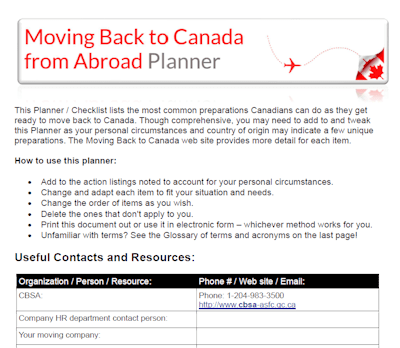 A ready-made and up-to-date planner of questions, considerations, and actions to take when preparing your move back to Canada, organized on a timeline approach. A companion tool to the full content on this web site.
Now available for immediate download. In easily editable Microsoft Word format so you can customize it to meet your planning needs. A PDF version can also be downloaded.
If you are in the U.S. and moving back to Canada quickly your purchase includes a "Moving back to Canada from the U.S. in 30 days or less", in Word and PDF formats.
Testimonial: "The list of tasks is very helpful as I'm a list person. Just love checking off the boxes!"
Bonus: Includes the guide: "Canada in 2026: 10 Insights to Empower Your New Life in Canada." Written by Paul Kurucz from his experience helping over 1,500 clients return to Canada, this guide will help you better understand the Canada you are coming back to!
Another Bonus: Includes the "Real Estate Selling and Moving Checklist" to help you prepare for your move back to Canada if you will be selling your house, townhouse, or condominium!
Purchase and Download now:
(PayPal, Visa, Mastercard, Amex)
Home | Feedback Contact | Get help - Professional Support for your move back to Canada
The resources on this website may be used for your personal use only. © 2003-2026 Paul Kurucz.