
Moving Back to Canada
Resources for Expatriate Canadians returning to Canada after living in the U.S. or further abroad


Moving Back to Canada
Resources for Expatriate Canadians returning to Canada after living in the U.S. or further abroad

Frequently Asked Questions
The FAQ's listed below are from Canadians living in the USA, UK, Australia, Hong Kong, the UAE, and many other countries who have visited this web site and have asked me questions that are of common concern.
If you have a question that is not listed below, please check out the full Moving Back to Canada web site. It is comprehensive, up-to-date, and free!
Still need help? Please engage professional support for your move back!
Note: This FAQ resource is updated regularly, so it is normally up-to-date. If you can help with any news or information that helps keep this page even more current, please let me know. Thank you! Latest update:
The Frequently Asked Questions:
Tax and Money Questions
- When I return to Canada do I have to pay taxes on the money I earned while living overseas?
- How much money will the government deduct from my pay in Canada? ("Canada is a high tax country")
- Should I move back to Canada on December 31st or January 1st of the following year for tax purposes?
Legal Questions
- What do I need to do to "become" a resident of Canada again?
- Can I bring my car (vehicle, trailer, RV, etc.) back to Canada?
- Can my foreign citizen husband / wife / spouse / common law partner come to Canada with me to live and work there?
- How do I give up my 'Green Card' when I move back to Canada?
- May I come back to Canada if I have had a criminal conviction in the U.S.? (or further abroad)
- I want to change my last name. When should I do this? before or after I move back to Canada?
- How do I legally move my children back to Canada after my spouse and I separate/divorce?
- How do I bring my wine collection to Canada with me?
Government, health, and airport/border questions
- Which provinces have a 3 month waiting period before I can get public health insurance?
- My old Canadian Social Insurance Number is "dormant". Can I get it back when I return to Canada? Or do I need to get a new one?
- How do I renew my Canadian Driver's License while I am living abroad?
- Can I purchase a vehicle in Canada, register it, license it, and insure it without having a Canadian driver's license?
- How do I fill out the BSF186 Form correctly? (formerly called the B4 form)
- Declaring CDN $10,000 or more at the Canadian border/airport when you arrive: Is this only cash? What about gold and jewellery?
General moving, setting up, and other questions
- I will have no credit rating in Canada when I move back! How will I get a credit card, car loan, or mortgage? Can I use my U.S. credit rating?
- Can I buy real estate in Canada before moving back?
- What can I do when I have no credit history or landlord references in Canada? How can I rent (lease) a house, townhouse, apartment, or condominium to live in when I move back?
- How do I replace my lost or stolen wallet and/or Canadian passport and/or other identification that I might need to return to Canada?
Is your question not here? Check out the full Moving Back to Canada web site or engage my professional support for your return to Canada.
Tax and Money Questions
When I return to Canada do I have to pay taxes on the money I earned while living overseas?
Answer:

Generally speaking, the answer is "no". If you were outside of Canada for at least two years, had few ties to Canada during that time, and established a clear and provable residency in another country for that time period you will be considered to have been non-resident by the Canada Revenue Agency (CRA). You will therefore not be required to pay tax in Canada on any non-Canadian sources of income or on capital gains accrued on non-Canadian assets.
You will still be liable for taxes on any Canadian sources of income and on accrued capital gains on Canadian assets during the time you were outside of Canada.
There are exceptions, however, to the above general rule. Here are some important examples of situations that can represent a significant residential footprint in Canada and may call into question whether you are actually residing outside of Canada or not:
- If you were gone only a short time - typically less than 2 years.
- If you own real estate in Canada that you still "live" in or have a fully dependent family member living in. This is someone who you fully support financially and legally. Further, the utility bills are still in your name and addressed to this property's location.
- If you have a licensed and insured vehicle in Canada in your name.
- If you renewed your Canadian driver's license while living abroad, doing so on a visit to Canada using a Canadian address that you state is where you are living.
- If you use a Canadian financial institution credit card regularly while living abroad.
- A REALLY big one: If you kept your provincial health insurance...and used it.
- A final super-big one: If you kept filing Canadian tax returns and paid income tax in Canada while living abroad. Yes, a few people believe they must file Canadian tax returns on their *foreign* income and pay Canadian taxes on it after they move abroad! YOU DO NOT!!
(Caveat: If you own real estate in Canada and rent it out, or have investment earnings from *Canadian* sources while living abroad, you do have to file a special Canadian income tax return).
A mix of some of these "ties" to Canada can be strong signals to the CRA that you were actually "residing" in Canada while you are physically outside of the country and you may be deemed for tax purposes to have maintained your Canadian residency. Therefore you will be liable for Canadian taxes on any non-Canadian earnings and accrued capital gains.
Another exception is if you work for the Government of Canada while outside the country. In this case, you are still considered a Canadian resident, unless you have some sort of special contract that stipulates otherwise.
Countries that have a tax treaty with Canada (like the USA) ensure that double-taxation does not occur. If you paid tax in the U.S. while living there, for example, you won't be taxed on your American earnings up to the point of your return to Canada.
In summary, the dividing line on the tax issue is pretty straight-forward for most people: If you live two or more years outside of Canada with a clear severing from key residential ties to Canada when you left then you don't pay taxes in Canada on your U.S./foreign earnings while you were away. If you have been gone a short time and/or maintained significant ties to Canada: You pay taxes in Canada on your world-wide income while you were away.
For more information on the tax question visit the Government of Canada's web site:
Individuals - International and Non-resident Taxes
Would you like to talk to a real, live person about tax, investment, or real estate questions you have as you plan your move back to Canada? I can help. Please use my professional support services to get private, confidential, and expert support for your current situation and return to Canada planning. - Paul Kurucz
FAQ Menu | Home | Professional Support
How much money will the government deduct from my pay in Canada? ("Canada is a high tax country")
Answer:
 Urban myth or truth? Is Canada a high tax country that leaves you much poorer every month than in the U.S., for example?
Simple answer: Canada is not a high tax country. You keep most of your income!
Longer answer:
There are a lot of factors that complicate this answer and lead to "apples versus oranges" comparisons that really don't make sense.
For example, is the government payroll deduction rate lower in the U.S. than in Canada? Yes.
Does this mean you automatically have tons more cash in your pocket every month in the U.S. than in Canada? Absolutely not.
If you compare overall costs of living between Canada and the U.S. over a 10 year period, for a middle class family of 4 who lead a healthy lifestyle, you will likely find little difference if you factor in housing price impacts, medical insurance costs, healthy food, and other factors.
Take home pay calculator for Canada:
A lot of people believe a myth that Canada is like Sweden - 80% of your pay goes to the government in taxes (not a fact, but yes, they do pay higher taxes in Sweden). The belief that Canada is a high tax country is simply not true.
Check for yourself: Here is a simple Canadian income tax calculator by Simple Tax:
Notes:
- If you are comparing the U.S. to Canada then it is important to take into account that different states in the U.S. have significantly different overall tax impacts or "tax burdens". For example, taking into account average property taxes, state income taxes, and total sales and excise taxes, New York State is the highest in the country, at 12.28% (in 2020). Other high tax states are Hawaii, Vermont, and Maine.
At the other end - the low end of overall tax burden - are states like Florida, Delaware, and Alaska (the lowest at 5.16%). Check your state: 2020’s Tax Burden by State. - Canadian provinces have more uniform income taxes but there are different sales taxes and of course, property taxes. Sales taxes in Alberta and the North West territories are the lowest at 5% while at the other end New Brunswick, Newfoundland, Nova Scotia, and Prince Edward Island charge 15%, with Quebec close behind at 14.975% (how did they choose that number?!). The whole list: Sales Tax Rates by Province
So, if you are moving from New York State to Alberta you are going from the highest state tax context to the lowest provincial tax context. If you live a high expenditure lifestyle this is important for you to understand. If you live a low expenditure lifestyle this may not be as serious an issue for you.
Finally, there are other taxes in the U.S. and Canada to consider, especially if you run a business. S. Crawford comments on his experience running a business in the U.S. in 2020:
And believe it or not, although personal taxes are higher in Canada, when I combined our taxes with our healthcare costs…it’s a wash and business taxes are much higher in the US than in Canada.
Final Important note:
Canada is truly an "apple" and the U.S, an "orange". A much better comparison to use than financial pay comparisons is "quality of life".
According to various "most livable cities" indices, Vancouver is typically about #5 in the world and Toronto is #15.
Where do U.S. cities rank? Not even in the top 10. Mercer's ranking puts San Francisco, the first American city to appear on the list, as #27 in the world.
Hmmm....now which country do you want to live in?
FAQ Menu | Home | Professional Support

Should I move back to Canada on December 31st or January 1st of the following year for tax purposes?
Answer:
Neither. For 95% of returning Canadians there is no tax benefit or cost to moving back on December 31st or January 1st of the following year...or any other day of the year.
Why?
Because you pay taxes in Canada on world-wide income earned, and capital gains accrued, only from the day you return to take up residence in Canada forward to the end of the calendar year. Any residual income or end-of-contract payouts from your time abroad that are received (not "earned") shortly after you return are similarly not taxed in Canada.
So, feel free to move back any time of the year!
And to be clear: You will not even declare foreign income or capital gains earned before you return on your first Canadian tax return, even if it was earned in the same calendar year as when you moved back.
So, who are the 5% who do have a move timing issue? No, they are not you. Seriously. They are very special cases, such as: "Someone moving back to Canada to start an already arranged job in Canada that pays > CAD $100k per year AND who is choosing to collapse a U.S. 401k pension which has a current value of < USD$50k". Or "Someone who is selling business assets or ownership shares with a complex multi-year payout including income/interest provisions in their agreement."
See? I told you it was not you. ;-)
If you are moving back to Canada with a complex set of variables to consider, such as the sale of a business and/or home, pensions, investments, a continued work relationship with an employer or customer in the U.S. or abroad, engage my professional support for your move back to Canada. There is a 95% chance you won't have a timing issue. But it will feel a lot better to have this assurance.
A real timing issue to consider:
Finally, there is a real timing issue to consider...but it is not tax related. Move back to Canada in May or June if you can. Why? Because moving back to Canada in October or November, at the start of winter, really sucks. You are entering 6+ months of cold, snow, wind, and mostly in-door living. Yuck. Not a great way to start your happy memories of life in Canada. (Unless, of course, you are moving back to southwest BC or Vancouver Island - these are the only two places in Canada that avoid real cold and long winter conditions. And outdoor winter activities in BC? These include skiing on some of the best ski runs in the world. 'Nuff said.)
FAQ Menu | Home | Professional Support
Legal Questions
What do I need to do to "become" a resident of Canada again?
Answer:

In some countries the government controls your residency even if you are a citizen of that country. This is not the case in Canada. You do not need to "register" your residency upon return. No police will come knocking on your door. In fact, there is no way to actually "register" your residency in Canada! There is no "Ministry of Residence".
That said, some government agencies are interested if you are resident or not. When you return, you are the one who triggers whether they know or not. Here are three parts to answering the question about becoming a "legal" resident of Canada after living abroad:
- In order to bring your personal belongings back to Canada without taxes or duties you have to verbally declare that you are a Canadian returning to take up residency in Canada when you cross the border either by land, sea, or through an airport. Your belongings and possessions, called "household goods" or "HHG" in movers terminology, must be detailed clearly and fully in a list you make up beforehand, or your movers make up for their "manifest" or "inventory". The BSF186 form you will need to complete, from the Canadian Federal Government's web site.
- In order to access services such as health care, to change over your driver's license, and to register your children in public schools you will have to show some proof that you are now living in Canada. This proof can include some combination of an apartment rental lease, utility bills with your name and address, provincial driver's license with your Canadian address, etc.
- Finally, on the first tax return you file yoiu complete after moving back you will have to declare the date you resumed residency in Canada so your taxes can be calculated on income earned from that point forward in time.
That's about it. Your residency is formally "declared" upon crossing the border if you are returning with belongings to follow after you. If you have no goods to follow, you "become" a resident immediately upon arrival without declaring anything to the government. Access to services begins when you register for these services (exception: Public health insurance, which starts 3 months after you arrive in most provinces) and tax implications begin when you get a job in Canada or file your first tax return.
FAQ Menu | Home | Professional Support
Can I bring my car (vehicle, trailer, RV, etc.) back to Canada?
Answer:
 Bringing a car, other motorized vehicle (an RV for example), or a non-motorized trailer back to Canada can be pretty straight-forward, complicated, or impossible. I strongly suggest that anyone considering "importing" their vehicle to research their particular vehicle situation carefully.
Note: You may only bring a vehicle into Canada from the U.S. - not from other countries.
If you are returning from the U.S. with a vehicle you will have to work through the Registry of Imported Vehicles (RIV) web site.
Suggestion: Start this process early!
The USA page of this web site has more information and several very useful client experiences and tips on bringing your vehicle(s) back from the USA when you return to Canada.
Why this FAQ?
Most people do their own vehicle importation process and it works out just fine. However, there can be complications if you do not prepare ahead of time. It does require some preparation and planning starting at least 30 days ahead! Some messages from clients and visitors to this web site about "importing" their U.S. vehicles into Canada when they moved back:
"What is interesting is that I did not know that if you import a car that is on the RIV list and is also 15 years old [or older] it gets in without duty, taxes, etc. and also does not have to go through the review process. Also the process for car exportation from the USA is a little complicated as you must get an appointment and process all the paperwork 72 hours before arriving at the border and leaving the USA. Also it is recommended by CBP [though not required and you most people do it themselves!] to hire a broker and do the process through it."
Another message of someone who did not prepare ahead of time for their vehicle being returned to Canada and suffered the consequences:
"...going thru hell right now, and have had a us car rental since the 1st wk in January; currently the 29th of January. have had to go over the rainbow bridge 3 times as of tomorrow it'll be 4 times to check on my car in a ford dealership, thank god for those guys, installed my day time running lights. so as such the resources would be good here, its a long drive from Niagara falls to Oklahoma city if I cant get the car over to Canada."
In summary: Start preparing at least 30 days ahead of your move (preferably 60 days) so that you get all the required steps done on the U.S. side and everything prepared for the Canadian side legally and administratively without having to panic at the last minute.
FAQ Menu | Home | Professional Support
Can my foreign citizen husband / wife / spouse / common law partner come to Canada with me to live and work there?
Answer:
Yes!

However, they must become a legal Permanent Resident (PR) to be able to stay, live, and work for the long term. Note: A pilot program was introduced a few years ago to allow spouses living in Canada to get an Open Work Permit which would allow them to work while waiting for their PR to be approved. This is now a permanent program. Great news for many!
Since creating this FAQ I have also built a more detailed resource on sponsoring spouses for PR status in Canada. Check it out for a more detailed exploration of the PR process (including a visual diagram of the sponsorship pathways) or continue reading below for links to resources.
The process of "sponsoring" non-Canadian citizen spouses is pretty clear and well-established. Here is the relevant Government of Canada link that explains everything:
Sponsoring when you are already living in Canada:
http://www.cic.gc.ca/english/information/applications/spouse.asp
Sponsoring when you are living outside of Canada right now:
http://www.cic.gc.ca/english/information/applications/fc.asp
Note: To be clear, your husband/wife/spouse will not immediately get Canadian citizenship - this is about getting them "Permanent Resident" status: the legal right to live and work in Canada. Application for Canadian citizenship is a related but different process that usually starts after your spouse has had a PR for 2 or more years.
An American comparable process to the PR is the "Green Card" versus "American Citizenship".
For more information on what a Permanent Resident is in Canada:
http://www.cic.gc.ca/english/newcomers/about-pr.asp
Do you have a a lot of questions or a more complex sponsorship / immigration situation? I recommend the services of a Regulated Canadian Immigration Consultant (RCIC). Here are three RCIC's I can recommend who are excellent at working with Canadians in the U.S. and anywhere in the world who are preparing to move back:
Trusted Regulated Canadian Immigration Consultants
FAQ Menu | Home | Professional Support
How do I give up my 'Green Card' when I move back to Canada?

Answer:
Relinquishing your U.S. Green Card, or "Abandonment of Lawful Permanent Residence", in official U.S. government lingo, can be done at a land border before you cross into Canada, sometimes at a U.S. consulate in-person (only a few around the world allow this anymore), or by couriering in U.S. Government form I-407.
Here is the official web site you can refer to:
"Abandonment of lawful permanent resident LPR status"
I regularly get asked by my clients about when and how to formally end "green card" status. The central concern most have is the time frame - how long to keep their green cards before relinquishing them. Obviously if they are fully committed to moving back to Canada permanently they give up their green cards soon after moving back - within the first month. Some are uncertain, however, or have other considerations (discussed confidentially with me) so they wish to wait awhile before giving up their legal status in the U.S.
How to give up your green card:
Many people have asked me if there is a best way. From the experience of my clients, here are the three ways to end your green card status in the U.S., in order of ease of doing so:
- Send it in by registered mail or courier. This is the easiest and least stressful way emotionally as there is no interview required. The address:
Copied from the USCIS website: (latest update to this: August 2025)
"Mail Form I-407 to our USCIS facility in Minneapolis, MN.
U.S. Postal Service (USPS), FedEx, UPS, and DHL deliveries:
USCIS
Attn: I-407
3 Intake Way
Minneapolis, MN 55438-1455
In very rare circumstances, a USCIS international field office or U.S. embassy or U.S. consulate without a USCIS international field office may allow you to submit a Form I-407 in person if you need immediate proof that you have abandoned your LPR status. The most common need for an expedited application is to apply for an A or G visa. You may also submit Form I-407 to a U.S. Customs and Border Protection officer at a U.S. port of entry."
Suggestion: Choose the "FedEX, UPS, DHL..." option. Use a courier to ensure your green card(s) and I-407 get to their destination with proof. Note: Do not send it "Signature Required". Feedback from Derek H. in Dec. 2022: "The signature part didn't work for me. I was informed by fedex that USCIS does not sign for any received packages. As a result, my package was returned to me, and I had to send it again, without the signature requirement."
Suggestion #2: Be sure to take a photocopy of the front and back of your green card and the I-407 form before you send them. And print out the email confirmation you get back from USCIS. Take all three pieces of paper with you if you plan to travel back to the U.S. in the first 90 days after you send them. Why? Because for up to 90 days the CBP may be accessing computer systems that are not yet fully up-to-date with your former green card status. With your photocopies + print-out of the email in hand you can show them why their computer doesn't match your current status. - At the border on your way out of the U.S. This works just fine but may be a bit stressful due to potential waiting times and interview questions asked. Recent reports from returning Canadians indicate that it goes pretty quickly and smoothly so this is likely the easiest and fastest way to relinquish your Green Card on your way into Canada and to establish your status other than mailing/couriering your green card in.
- Visit a U.S. Consulate As noted above, this can still be an option in some places, but with restrictions. Check the U.S. Consulate nearest you in Canada for their hours and the process for you to follow if they *still* allow Green Card & I-407 form submissions there.
Re: Options 2. or 3. above, one possibly startling question returning Canadians have been asked verbally and in writing when they gave up your Green Card at the border: "Is this move in any way politically motivated?"
Just giving you a "heads up"...don't take the bait!!
FAQ Menu | Home | Professional Support
May I come back to Canada if I have had a criminal conviction in the U.S.? (or further abroad)
Answer:

I met with a CBSA Officer to seek first-hand information to answer this question. Generally, the answer can be "yes", you may move back to Canada if you are a Canadian citizen and have had criminal convictions in the U.S. or further abroad in the past. However...
...a few notes:
- The CBSA Officer you talk to at the land border or airport when you arrive has the power to let you in, or not. It is important, therefore, to be careful to understand how your past convictions will be assessed. The web site noted below details what you need to know.
- The key wording is "past convictions". Any outstanding warrants, on-going legal proceedings, recent convictions, etc. in the U.S. may result in you not being admitted into Canada. If you are really "done" with all legal complications in the U.S. or further abroad, you are in a good position to return and be allowed back into Canada.
- You will be allowed into Canada if you have outstanding debts in the U.S. or abroad, for example. However, outstanding warrants for your arrest, fraud, skipping bail, pending court proceedings, serious recent convictions, etc. are the challenging situations that may make you inadmissible into Canada.
- If you left Canada with outstanding criminal or civil legal challenges outstanding in Canada when you left, you may find yourself challenged by CBSA officers when you arrive at the border, or even arrested at that time, depending on the severity of the situation when you left. In this case it is highly advisable to seek legal counsel - a Canadian lawyer - before you arrive, to help assess your case.
The official Government of Canada "Overcome criminal convictions" page.
In summary, having a complicated life legally in the past does not mean you can't come back to Canada. It does mean, however, that you need to understand how the past may impact you so you can return to Canada with confidence.
FAQ Menu | Home | Professional Support

I want to change my last name. When should I do this? before or after I move back to Canada?
Answer:
Scenario: You are moving back to Canada *soon* after a change in marital status and you wish to change your last name. Now, however, you have a Canadian passport in your married (or pre-marital) name, and perhaps the same last name on a second country passport, driver's license, pension, legally registered on a real estate title, and more in Canada and/or in the country you are moving back to Canada from.
I hear that there can be strong emotional reasons to change your last name promptly when you have a change in marital status and I honour that changing it right away may feel really good. That said, changing your last name shortly before, during, or immediately after a return to Canada can cause you grief in terms of legalities and logistics because different government systems take differing amounts of time to receive, process, update, and acknowledge name changes.
So, if you don't have many months of time left before you move back (greater than 6 months), please consider changing your name *after* your move is done and fully completed.
To be clear: The best time to change your name is BEFORE you return if you have complicated non-Canadian legal context because it is normally much easier to change a name while in the country you are going to leave, particularly if it is far away (Australia, UAE, Hong Kong, etc.) But again, if you only have a few weeks or a month or two left before you return, waiting until you are back in Canada and fully settled is by far the easier time to change your last name from a legalities and logistics perspective.
Finally, if you choose to change your last name before you move, do so completely: All your ID, foreign and Canadian. This will ensure that you have consistent ID when you return. While you can carry a legal marriage or divorce certificate to prove your name change having mixed names on different forms of ID complicates your life when you return to Canada and want to set up government and other services. Why? Because Canadian federal, provincial, and local governments and businesses are now getting tough on having consistent ID due to fraud issues.
FAQ Menu | Home | Professional Support

How do I legally move my children back to Canada after my spouse and I separate/divorce?
Answer:
I will not soften this topic: It is usually a tough situation for the parent wishing to move back to Canada with her/his children. The other parent - the one who is being "left" when the initiating parent wants to move back to Canada - typically has the legal right to be involved in the lives of their children ("access to their children"), meaning that it is very difficult to move children out of a state/region/country without their written and legally attested permission.
"So, that's it? I just give up and resign myself to being stuck here until my children are legally adults?!"
No. Some considerations:
- First and most importantly: If you and/or your children are being abused or under real threat of physical, mental, or emotional abuse, take immediate steps to physically remove yourself and your children from the situation. Period. Go to a family member, friend, or transition house and seek police, social services, or other help to ensure you and your children's immediate and long-term safety.
Safety is a human right and it is the responsibility of each parent to ensure that their dependent children are kept out of harm's way. Once you are safe and have taken legal action to protect yourself and your children, you can begin a process to move back to Canada within the legal system of many countries. Getting the right to move your children to Canada can happen under such circumstances, even against the other parent's wishes. - Surprisingly, many parents will agree to allow their children to leave to move back to Canada! Why? It frees them from the responsibility of having to raise their children, allows for a more peaceful marital separation, frees them to build a new relationship with someone else, and from a sadder human reality makes some feel like a victim/martyr ("My Ex took my children away") or makes them believe they will be able to keep more money for themselves after you and the children leave. Whatever the reason(s), with careful negotiation, right timing, and patience, you may be able to get the other parent to agree to you moving back to Canada with your children.
- If your personal situation and that of your children is very logistically challenged (no money, job, dangerous living conditions, etc.) and the other parent is not able to support their children, you can get the legal system in many places to allow you to leave with your children. I have heard of this happening for one parent in the UK who shared their story with me. It took 18 months to work through the legal system where they were living, and the Canadian system on this end, but they got the right to leave with their children to move back to Canada. A long road to follow in most cases, but one that is possible if you are in challenging circumstances where you could create a better life for yourself and your children in Canada.
- GlobalARRK. If you are somewhere in the world that does not have a strong legal system and/or has legal or social constraints that will limit your mobility options, this organization may be able to help. "Action on Relocation and Return with Kids" and "Supporting Stuck Parents: those who have moved abroad and cannot legally return to live in their home country with their children".
A Canadian's story of being stuck, on this web site.
In summary, feeling you may not be able to move back to Canada with your children can be a big challenge emotionally and psychologically. Fact. And yes, you may be stuck for some time. Acknowledging these realities may actually be the first step to finding a path forward...a path that with patience can lead you to the freedom and life you desire and need for yourself and your children.
FAQ Menu | Home | Professional Support

How do I bring my wine collection to Canada with me?
Answer:
The answer to this question is a bit more complicated than what can be quickly summarized in an FAQ, so I produced a separate resource page for this question:
"Moving to Canada with a wine collection?"
FAQ Menu | Home | Professional Support
Government, health, and airport/border questions
Which provinces have a 3 month waiting period before I can get public health insurance?
Answer:
 The provinces of British Columbia, Ontario, Quebec, and New Brunswick have normally had a 3 month waiting period before you can access public health insurance. And so does the Yukon Territory. In all other provinces you have been able to become insured immediately.
Note: Ontario suspended their 3 month waiting period in 2020 and has not yet resumed it as of the latest update of this FAQ (August 2025). Check the OHIP website regularly in case this changes.
For the 3 month waiting period you can buy private health insurance. It is available through many major Canadian insurance companies.
One commonly used plan is offered by Blue Cross, which offers both visitor/traveler insurance AND a plan for those waiting for the 3 months before coverage starts. Here are their plans for Ontario:
Blue Cross Ontario Visitors to Canada Plan
"The Visitors to Canada plan provides up to $50,000, $100,000 or $150,000 (based on the chosen option) in quality insurance coverage for non-Canadians and their families travelling in Canada or to returning Canadians that are not eligible to government health insurance plan due to an extended leave." (bolding added)
British Columbia (BC):
Note: BC has a special system: You wait 2 months + the remainder of the month in which you arrived in Canada. If you arrive on the 15th of a month, for example, you wait 2 months + 2 weeks for your BC Medical Services Plan ("MSP") to kick in.
Pacific Blue Cross Visitors To Canada Plan
"For returning Canadians awaiting eligibility for the Government health insurance plan to begin."
Tip: The Pacific Blue Cross plan also covers travel to the U.S. and Hawaii, in case you wish to travel there during the 3 month waiting period! Check out the fine print of any policy...there are sometimes great bonuses built in!
(This tip shared by Tania T., returning to Canada from Australia. Thank you, Tania!)
An alternative to the Blue Cross plans in Ontario and BC are very similar "Visitors to Canada" plans offered by the Canadian Automobile Association (CAA) in Ontario and the British Columbia Automobile Association (BCAA). These are very safe, trustworthy organizations and their insurance policies will also serve you well.
Note: Paul Kurucz and this web site have no affiliation with Blue Cross, CAA, or BCAA, and do not receive any compensation for referrals to these organizations.
FAQ Menu | Home | Professional Support
My old Canadian Social Insurance Number is "dormant". Can I get it back when I return to Canada? Or do I need to get a new one?
Answer:
 Your Canadian Social Insurance number ("SIN") is used for all federal government services, by your employer to deduct and remit income tax, and for government benefits you receive. It is yours for life. After 5 years of it not being used (because you were living abroad), the Canadian government will make your number "dormant" to protect it from fraudulent use.
One important point: Your SIN being dormant does not stop you from moving back to Canada and setting up your life here. It is primarily an "information collection" number. With your SIN dormant you can still get a job, open a bank account, get your driver's license, sign up for health care, etc. So, don't worry: There is no rush to get it taken out of dormancy.
What your SIN needs to be active for: Accessing online information about yourself through the Government of Canada's web sites such as CPP and OAS benefit information, RRSP and TFSA contributions in the past, and your taxes paid in the past. An active SIN is also required to start receiving government of Canada benefits such as employment insurance, CPP, and OAS.
A few options for taking your SIN out of dormancy:
- On a last vacation or scouting trip before you move back, or when you return permanently, visit a federal government "Service Canada" office to have your Social Insurance Number "turned on" again.
Service Canada Office Locations: http://www.servicecanada.gc.ca/tbsc-fsco/sc-hme.jsp - Alternatively, you can also initiate this process from outside of Canada by contacting Service Canada and getting a form they need completed (with proof of who you are) and sending it to them.
- An option that *may* work is to apply for a new SIN online through the Government of Canada web site. I have heard that this results in your SIN being reactivated quicker and easier. If you have had this method work for you please let me know. (Thank you!)
FAQ Menu | Home | Professional Support
How can I renew my Canadian Driver's License while living abroad?
Answer:
 Every province has their own driver licensing process, and all are a bit different. Below are British Columbia and Ontario processes, as examples. For other provinces, just Google: "[Province] Driver's License renewal" to find the appropriate provincial web site that explains that province's process. For all provinces, see the "IMPORTANT:" note below.
For Canadians with a BC Driver's License:
You must renew your BC Driver's License only while physically present in BC so that you do it in-person. ICBC, which handles licensing of drivers in the province, has a simple web site that explains your options:
ICBC driver's license renewal information
In summary, they are pretty easy going - you can renew 6 months in advance or up to 3 years after it has expired. Note, however, that you cannot drive in Canada after it expires. If you go over 3 years and are not living in a place in the world with a driver's license reciprocity agreement, you will have to apply as a new applicant, with a written test, road test, etc. when you return. YUCK!
For Canadians with an ON Driver's License:
You must renew your Ontario Driver's License in-person unless your renewal form says you don't need a photo taken. Like BC, Ontario gives you 180 days ahead of time to renew, so that you have plenty of time to get it done. However, they seem stickier than BC on expired driver's licenses:
"You can renew an expired driver's license, without taking tests, within one year of the license expiry date." Note: This applies to regular licenses, not learner permits, temporary, suspended licenses, etc. After one year but less than 3 years, you will have to take a vision test, too. After 3 years Ontario is like BC: You have to start the licensing process from the beginning (TESTS!) if you are moving back from a place that does not have reciprocity with Ontario.
In summary, like BC, you have some leeway both before and after your regular driver's license expires in Ontario. Here is the Ontario web page that explains all the options and details:
http://drivetest.ca/licences/licence-exchanges/licence_exchange.html
IMPORTANT:
Renewing a Canadian driver's license has implications for your residency status. If you are living outside of Canada and renew your Canadian driver's license at that time (while on a vacation trip home, for example) carefully weigh renewing it against all your other ties to Canada. A driver's license renewal by itself is a very small tie to Canada. Renewing plus having other ties to Canada, such as an active Canadian credit card and other ties might constitute a case for the government claiming that you are actually still a resident of Canada, with resulting tax implications.
FAQ Menu | Home | Professional Support
Can I purchase a vehicle in Canada, register it, license it, and insure it without having a Canadian driver's license?
Answer:
Yes!
 If you are moving back to BC, specifically, and do not have a valid BC Driver's License (BCDL), you may still purchase, register, license, and insure a vehicle in BC. You are required to have a driver's license to drive the vehicle, but it doesn't have to be a BCDL.
The catch: In order to get a discount on your insurance for your safe, no-accident driving, you require a BCDL. This means you will pay full-price for your insurance without a BCDL.
When you do get a BCDL, and you bring a record of your clean driving history from another province or country within 6 months of the start of your insurance policy, you will get a discount, pro-rated back to when you applied for the insurance, according to my conversation with ICBC, British Columbia's public vehicle insurer.
Here are the details: Insurance Discount for New Residents (ICBC)
A note about Manitoba:
"Manitoba appears to require you to be a "Manitoba resident" to register a car there, but MPI's website rate calculator appears to suggest it is possible to register and insure a vehicle there without a Manitoba driver's license, but you will not get any rate discount. The rate calculator also allows you to get a insurance quote as a "non-resident" and it is actually cheaper than a quote given for a resident (for lay-up coverage). Very weird."
- Mike G. (Thank you, Mike, for sharing this!)
Note: I have no information on other provinces. Can anyone help me with this for other Canadian provinces?
FAQ Menu | Home | Professional Support
How do I fill out the BSF186 form correctly? (formerly called the B4 form)
Answer:
 The BSF186 form is for importing your personal household goods that you ship to Canada and that arrive AFTER you come to Canada. Canada Customs wants to see a list of what you are shipping into Canada to ensure that you are NOT bringing in the following:
- Banned items such as ivory.
- Restricted items, firearms.
- Controlled items, such as wine collections.
- Commercial items for resale.
And they want to see any new, expensive items, such as a brand new C$5,000 MacBook Pro or a new $15,000 Persian rug because for these items you may have to pay taxes and duties if you have not lived outside of Canada for 5 or more years.
What do you put on your BSF186 form? Individual items? Groupings? And what values?
Here are examples for you to follow if you are moving yourself (you are not using professional movers). The key is to use general groupings and nominal "used" or "garage sale" values for all your used household goods, except brand new very expensive items (less than 6 months old that may possibly be subject to tax and duties):
Books - $50
Kitchen items - $100
Clothes - $0
Living room furniture - $200
Television - 3 years old - Sony XBR85 - Serial number [XXXXXXXX] - $400
...etc.
However, you only have a few rows on the BSF186 form to put a longer list of your items! So, you can make up a full list of what you are shipping using a Word Processor or Spreadsheet program, print it out, write "see attached" on the BSF186 form, and attach your list to the form.
Note: If you are using professional movers to pack and move with it is best to attach the mover's inventory (also called a "manifest" or "bill of lading") to the BSF186, not your own.
What about belongings you bring with you in your vehicle when you cross the border, or in your luggage when you arrive at a Canadian airport? For these belongings, make up a simple list of what you have with you to show the Canada Customs Officer. No BSF186 form needed for what you have in your vehicle or luggage, only for household goods that are arriving by shipment after you get to Canada yourself - called "goods to follow".
FAQ Menu | Home | Professional Support
Declaring CDN $10,000 or more at the Canadian border/airport when you arrive: Is this only cash? What about gold and jewellery?
Answer:

I went to a CBSA office here in Canada and asked them this question in-person. Here is what you must declare when you arrive at the border of Canada by land or airport: All of the following that individually, or as a total, add up to CDN $10,000 or more:
- Cash - CDN, USD, or any other currency.
- Gold bars, mint-issued gold coins, or other forms of gold and precious metals (not jewellery - see below).
- Gem stones - i.e. 20 diamonds you intend to convert to cash at some point
- Endorsed cheques (spelled "checks" by our American cousins)
- Money orders
- Physical stock and bond certificates, particularly "bearer bonds"
- Reference for what are considered "financial instruments" according to the Canadian government: Revenue Canada Act Section 17-1: definition of financial instrument
What is not included? Personal jewellery. If you have jewellery that you have owned for a long time (with receipts to prove), and intend to keep in the future for your personal use (not re-sale), this is not part of the $10,000 currency reporting amounts. Note, however, that any single jewellery items worth CDN$10,000 may be charged duties and taxes if you purchased it/them abroad.
Important Note: Prepare Form E677 before you arrive if you are bringing more than $10,000 total in cash, gold and silver bars and coins, etc.
Suggestion: PLEASE don't bring really expensive jewellery, high values of gold, or other currencies with you when you travel! If you have over $50,000 in value for any of these, please use a secure shipping company instead - one that specializes in shipping valuables. This is just for security reasons! Thieves are smart: They seek information on people carrying valuables and can target you with sophisticated methods so as to relieve you of your valuables. Canada is generally a safe country and less of this kind of theft happens here than in other countries in the world. But it can still happen here, too.
Finally, to answer a related question: No, you will not be taxed on the CDN $10,000 or more when you declare it. Seriously: No. Your legally and legitimately earned and owned money, pure gold and silver bars and coins, and other financial assets are not going to be taxed when you bring them back to Canada as part of your return to take up residence again.
FAQ Menu | Home | Professional Support
General moving, setting up, and other questions

I will have no credit rating in Canada when I move back! How will I get a credit card, car loan, or mortgage? Can I use my U.S. credit rating?
Answer:
Don't worry!
Lack of a current credit rating in Canada is a common concern of returning Canadians and those new to Canada. Without a recent credit history and up-to-date credit rating they are worried they can't get a credit card, utilities set up, a car loan, or a mortgage.
But the reality is that a lack of a recent Canadian credit history is not a major hurdle for most people! In fact, once you have set up a bank account in Canada and have some funds deposited in it you can get most things done financially with little hassle. For example, you can usually get:
- a credit card - secured or unsecured
- cell phone service
- utility accounts
- a car loan
- a line fo credit
- and yes...even a mortgage!
Can you use your U.S. credit history?
Most Canadian banks, credit unions, and trust companies do not recognize U.S. credit histories. Nor do utility companies or car financing organizations. The one exception relates to mortgages. A few lenders will consider your U.S. credit history as part of their overall determination of whether to offer you a mortgage (see tip below on mortgages).
Setting up a bank account and credit card:
You can set up a bank account on your last visit to Canada before you move here or remotely from abroad, though some banks (RBC, TD, and maybe others) now allow the opening of a bank account from abroad (with restricted features). Details on this: Opening a bank account from outside of Canada.
Tips:
- Keep your U.S. or foreign bank account and credit card for at least a month after you arrive so that you have them for emergencies before your financial services are fully set up here in Canada.
- Building a credit rating in Canada happens very quickly. Within 3 months of paying your bills on-time you are "back in the game" with a decent credit rating and will have all the credit you need. Within 6 months, you have a good credit rating and can access lines of credit, loans, and mortgages at preferable rates. It does NOT take years!
- Shop around! Please don't take the first institution's response as fact. Or the word of a friend or family member who asks at their local bank branch and hears from the 22 year old loan salesperson (who does not deal with expats or recent returnees and is only 2 months on the job) that you can't get a loan without a credit history. Or a comment you read on social media about how someone couldn't get _____ financial service and how miserable they are. Of the over 1500 clients I have personally supported in their moves back to Canada I have never heard from one who found their lack of a current Canadian credit history was a significant hurdle in getting their life set up again in Canada. Shop around and you will find some doors open immediately and simply at some financial institutions. "That was easy!" you will say.
A quote from a client: "Was able to secure a credit card with a $9000 limit…not sure how that happened without any credit history"
However, here is a different experience to be aware of ("shop around" is the lesson from the following story):
"We had a devil of a time getting a credit card, of all things. Even though we'd banked at RBC for over 40 years, and maintained our account (and used it), we simply could not get a credit card through RBC. I probably made the mistake of being honest about our annual income - which was about $40k. Even meeting in person with the banking officer in our home town, proved our (substantial) net worth, proof of a mortgage-free house, US 800+ credit score, etc. - nope, not approved. We finally got a CC from the bank my wife's business uses." - Need a car loan? You can usually buy a car on credit through a new car dealer though they may want a larger down-payment on the purchase. Even better: A used car dealer will fall over themselves trying to lend you money for a vehicle purchase. Why? Because they make money two ways: Selling you the vehicle and loaning you the money to buy it. As interest rates are so low on savings used car dealers are normally quite eager to loan money at any rate higher than a bank will give them. So in most cases, you can get a decent car loan rate. Of course, shop around for the best deal you can get!
- Need a mortgage? Check out my dedicated "Buying Real Estate in Canada" resource to learn about getting a mortgage in Canada as an expat or recent returnee. Really, you can get one!
In summary, most people are concerned that they won't be able to get a bank account, credit card, utilities set up, a car loan, or a mortgage when they return - the typical things a good credit rating will expedite. Trust that a lack of a credit rating won't seriously hinder you getting everything you need in short order when you move back to Canada.
FAQ Menu | Home | Professional Support
Can I buy real estate in Canada before moving back?
Answer:
 Yes! You can buy real estate in Canada before moving back. You are legally allowed to do this in all provinces, however, in BC and ON there are some complications as to non-resident buyer taxes applicable in some areas.
The decision as to whether to buy real estate in Canada before moving back depends on many factors, however. Everyone's situation is a unique one. Here are some things to consider when thinking about buying real estate in Canada before moving back:
- Location: If you know exactly where you are going to move back to in Canada it is easier to decide to buy real estate ahead of your return.
However, are you planning on returning to the same place in Canada you lived when you left?
Have you considered that you have changed since you have been living outside of Canada and if you left 10, 20 or even more years ago, you are now at a very different life stage than when you left?
Where you "come from" in Canada may no longer be the ideal place to return to. Many returning Canadians now choose their target location in Canada based on the lifestyle they wish for now and in the future rather than based on the lifestyle they had when they left to go to the U.S. or abroad long ago.
How does this lifestyle choice affect a real estate purchase? Well, if you have any uncertainty about where in Canada you really want to live don't buy a home ahead of your move. Instead, take a couple of weeks to visit Canada as an exploratory "how does this feel?" tour and/or consider renting a place for awhile before buying. I see many people renting for a few months in Victoria, Vancouver, Kelowna, Ottawa, Montreal, and Halifax as "test runs" to determine if they want to live permanently in these places. - Legalities: There are no legal reasons you cannot buy real estate in Canada before you return if you are a Canadian citizen. That said, buying real estate and renting it out or leaving it vacant until you return will likely have tax implications that you must be aware of to avoid penalties later.
- Taxation: Owning real estate in Canada will not, by itself, make you a resident of Canada for tax purposes. But, you do have to take precautions to ensure that your real estate in Canada is handled properly with the Canadian government. For example, if you are a non-resident landlord then you must handle rental income differently than if you were resident in Canada. Monthly Canada Revenue Agency (CRA) NR4 filings with 25% of gross monthly rental receipts are required for all rental revenue received by non-residents.
Of special note: In some popular places in BC and Ontario, non-resident Canadians must now pay a tax for the right to purchase and own property. Something to be aware of. - Price: Many Canadians have been returning from the U.S., Hong Kong, and the Middle East and taking advantage of the USD/CAD exchange rate differential to buy real estate in Canada at a discount. However, as of 2021 prices of most real estate in Canada have become so astronomically high in most cities that this differential does little to help.
Obviously, real estate can be purchased at lower prices outside of Vancouver or Toronto. Visiting Canada ahead of a real estate purchase is strongly recommended to ensure that you understand the nature of price levels in the specific geographic area you are considering, including the part of a city you are targeting. Too many variables are "at play" in our economy at this time and you want to be sure you really understand them before you buy real estate anywhere in Canada. - Mortgages: If you need a mortgage to buy real estate in Canada, and the mortgage would be a large percentage of the price, this will pose a challenge while you are non-resident. Traditional bank or trust company lenders do not understand the non-resident reality and you will have to work a bit harder to get a mortgage arranged, but it is very doable with the help of a mortgage broker. Please see the note below on my new resource page on buying real estate in Canada which can be of help in this regard. As well, the Roadmap / Planner can help you navigate the mortgage and purchase process (also see below).
Many of my clients want to buy real estate in Canada prior to their return. During my consultations with them we explore a range of financial, tax, logistics, and lifestyle considerations prior to a purchase. This gives them significantly more clarity and confidence for their purchase considerations.
Because this is a more complicated investment, I always recommend being very careful with your research, planning, and lifestyle considerations before buying Canadian real estate if you are still a non-resident of Canada.
Check out the "Buying Real Estate in Canada" resource page on this site, for Canadians returning to live in Canada and Canadians living abroad and wanting to invest in property in Canada.
Real Estate in Canada Roadmap

Ready to buy real estate and just need a Roadmap / Planner to guide your journey?
"The Thoughtful Expat's Guide to Buying Real Estate in Canada" is for you!
This Roadmap / Planner is a combination step-by-step guide, checklist, and education tool that will safely and confidently walk you through a real estate purchase. It starts with the research phase and ends with what to do in the first 30 days of you owning your property. It has been contributed to and regularly reviewed by real estate professionals to ensure it is as up-to-date as possible. Includes a glossary of terms you will need to know!
You can download PDF and Microsoft Word versions, the latter allowing you to tweak and customize the Roadmap for your needs and circumstances!
As the real estate market and process for buying property is evolving regularly, you will be notified of new editions of this Guide so you can download them for free.
Currently available in Ontario and British Columbia editions in Microsoft Word and PDF formats. After purchasing you can download all the editions and versions.
FAQ Menu | Home | Professional Support

What can I do when I have no credit history or landlord references in Canada? How can I rent (lease) a house, townhouse, apartment, or condo to live in when I move back?
Answer:
I once saw an application to rent an apartment that was 4 pages long and asked for an incredible amount of information, including bank account numbers, credit card numbers, etc. I just laughed and put about 1/4 of what was asked.
That was all the landlord actually needed. No previous landlord references, to be clear. I did put a personal one, but it wasn't even checked.
There is a lot of fear that comes up when considering renting an apartment, condominium, or house. "Will I win the lottery among all the people who apply?" "Will I be seen as a good potential tenant?" "Will I be rejected because I don't have a credit history in Canada?"
This fear makes it hard to get over the fact that a good tenant is an asset to a landlord. If you are returning home to Canada and planning on renting a place, here are a few things you can do to help yourself more easily rent a property - and feel good about the process, too:
- Talk to property managers, leasing agents, and landlords yourself, in-person. No, don't try to rent a place completely by text message, email, Whatsapp, or even by phone from abroad. Arrange to meet in-person. I estimate that 75% of the decision criteria landlords use is from their interpersonal interactions with a potential tenant. Since they cannot legally screen potential tenants using certain variables that are also impossible to identify from electronic communications, they rely on in-person conversations and "live" assessments of potential tenants.
- You might say "Yuck! Having to meet a potential landlord in-person makes my situation worse!!" Actually, quite the opposite: You are just returning from living in the U.S. or further abroad. And what the landlord sees: You have money! "All Canadians who lived abroad have money. That is why they went abroad - to make money." Your time outside of Canada can be seen as an asset, whether you actually have a lot of money or not!
- And "NO!!" (said emphatically). Your race, gender, age, etc. are NOT the variables potential landlords use to screen potential tenants. Instead, they are looking for openness, honesty, maturity, conscientiousness, stability, cleanliness (hint: How you dress and present yourself = how you will take care of your rental property in the minds of a landlord), your expectations, your requirements, your lifestyle, your employment, etc. These are things you have control over presenting when you meet and communicate with potential landlords!
- In some places, you can engage the services of a real estate agent or personal representative to help you lease a place (I do this for some of my clients moving to Vancouver or Victoria). This agent or representative adds credibility to your story. When I arrive to view a property on behalf a client who can't make it to Canada to do so themselves, I ensure that my client is presented in the best light possible. And because I arrive professionally dressed and act professionally I am the proxy for my clients being trustworthy tenants.
As an aside, Toronto is an example of a city in Canada where a real estate agent actually makes a commission from a signed lease so they are motivated to find you a place and get the landlord to accept you as a tenant. Most small or medium sized cities in Canada do not have this kind of arrangement with real estate agents. - If your first communications with a potential landlord is electronic, be sure to let them know you are a "Canadian citizen returning home to Canada after having lived and worked in _____". Not: "I was surfing in Hawaii for 5 years and am now moving back to Canada because I am broke and need a job." This is an exaggeration, of course, but you get the idea: Present yourself as an interesting and desirable potential tenant.
When you send an application for tenancy, include a cover letter which includes the 3 reasons you will be a great tenant. Like with a cover letter for a job application, a rental cover letter sets you apart from 99% of others who do not do this. Hint: I did this once in a tight rental market and the property management company was VERY pleased to rent the house to me. From the way they treated me, there was no question that I was the #1 potential tenant.
Important note: If you are asked to wire-transfer a deposit after electronically communicating with a potential landlord, or are asked to pay funds in-person to "hold" a rental, for example, do not agree to this request and never send or give this money. There are regular scammers who fleece unwary and innocent renters and disappear with their money in major cities in Canada. You show up at your "rental property" to find the owners are at home and are very surprised to meet you, knowing nothing about any rental of their property. Two people I personally know who moved to Canada from India got scammed this way for thousands of dollars.
Please don't let this be you! I know you are concerned about renting a place. Having a place to move into when you arrive back in Canada will be a huge relief. But don't jump at the first opportunity to do so. Come to Canada first to visit, or stay in a short-term accommodation when you get here permanently first. Take the time to seek the perfect place from a reputable property management company, real estate agent, or landlord.
FAQ Menu | Home | Professional Support
How do I replace my lost or stolen wallet and/or Canadian passport and/or other identification that I might need to return to Canada?
Answer:
 Losing your wallet and ID while overseas is a pain. There are typically several hoops to jump through to get new credit/debit cards, ID, and passports. A few suggestions, should you find yourself in this situation:
Act immediately on the following fronts:
- Contact the local police and file a report if you are sure of a theft. You may need a copy of this report for later bureaucratic hoops.
- Contact your bank and get your credit and debit cards cancelled and re-issued if you have lost your wallet.
- Contact the nearest Canadian consulate or embassy and engage their help with replacing your passport.
- If you are employed overseas then advise your employer of your situation and engage their help with any legal issues around replacing your lost/ stolen documentation. Often times your legal right to work in a country is tied specifically to your employer, not just to you. For example, you may need to get replacement proof of your work visa.
- Let some close friends know your situation. You may need their help to vouch for you to authorities.
Considerations:
Be proactive in getting the process underway. Replacement of your id is an urgent priority in your life. Don't delay.
Do not try to travel regionally in your country of residence or internationally without your ID. Not every country has internal freedom of mobility as we do in Canada. And getting caught without your ID is often seen as a very suspicious situation by foreign police and officials. Don't risk it.
Relax! You are not the first person to have their ID stolen. It happens. You likely not have been negligent. Just unfortunate. Replacing your ID follows well established processes, though will take a bit of time and money.
Resources: (all links open a new browser window)
Government of Canada - "Lost or stolen belongings abroad"
Government of Canada - "Lost, stolen, inaccessible, damaged or found passports"
Government of Canada - "Canadian offices abroad"
FAQ Menu | Home | Professional Support
Would you like help with your move?

Would you like help with your move?
Would you like help with your move?
I offer professional support to help you prepare for a smooth and easy return to Canada so you can feel confident and organized!
Your questions about when to move back, taxes, investments and finances, bringing back your household belongings, health care, and more will be answered promptly and professionally, with resources to back up what you need. My 23 years of supporting over 1,500 clients gives me a depth of expertise across all aspects of planning and returning to Canada.
Paul Kurucz - Canada
A happy client:
Hi Paul,
Just to update you - we landed and sailed through customs! So thank you so much for all of your advice...It was a thoroughly pleasant experience.
This is to say thank you for everything. Your advisory has been so incredibly helpful and saved us considerable time and removed room for error.
With best wishes,
Caroline
Paul's professional support
Moving Back to Canada Planner!
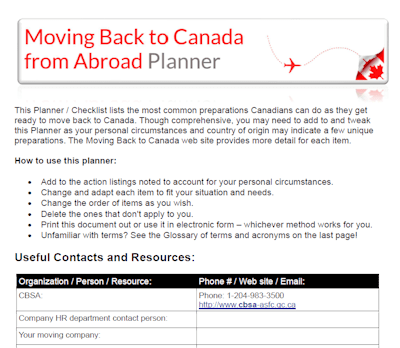 A ready-made and up-to-date planner of questions, considerations, and actions to take as you prepare for your move back to Canada, organized on a timeline approach. Save hours of work and stress of trying to piece everything together. A companion tool to the full content on this web site.
Now available for immediate download. In easily editable Microsoft Word format so you can customize it to meet your planning needs. Also in PDF format.
NEW! If you are in the U.S. and moving back to Canada quickly your purchase includes a new edition as well: "Moving back to Canada from the U.S. in 30 days or less", in Word and PDF formats.
Testimonials: "Your moving guides and checklists are unbelievably helpful - frankly I don't know what I would do without them. You have covered everything including many, many things I would not have thought of. Thank you!!!" - C.W. April 2022. "The list of tasks is very helpful as I’m a list person. Just love checking off the boxes!" and "I must say I truly appreciate having purchased your guide to moving back to Canada. While we are still a couple months away it has really helped me keep all the "balls in the air".
Bonus #1 ! Includes the guide: "Canada in 2026: 10 Insights to Empower Your New Life in Canada." Written by Paul Kurucz from his experience helping over 1,500 clients return to Canada, this guide will help you better understand the Canada you are coming back to!
Bonus #2 ! Includes the "Real Estate Selling and Moving Checklist" to help you prepare for your move back to Canada if you will be selling your house, townhouse, or condominium!
Purchase and Download now:
(PayPal, Visa, Mastercard, Amex)